5th Grade Math Lesson Plan
Master the order of operations with this engaging, Common Core-aligned 5th-grade math lesson and activity.

Author
Katie Wickliff

Published:
March 2026
Key takeaways
- • Learning the order of operations prepares 5th graders for more advanced math
- • To teach this concept, combine explicit instruction with focused practice and an engaging activity
- • Our sample lesson can be adjusted for different learning needs and abilities.
By 5th grade, students are expected to have a solid foundation of the four operations: addition, subtraction, multiplication, and division. In this lesson, they build on their knowledge by using the order of operations to solve more complex problems. Through a combination of direct instruction, guided practice, and a fun partner activity, students will feel confident and ready to tackle their next math challenge. We’ve even included ideas for students who need extra support or an additional challenge. After the lesson, head over to Dreambox for extra practice tailored to your unique learners. This online math program provides students with a fun, interactive way to strengthen math skills and concepts.
Sample Place Value of Decimals Lesson Plan
Lesson Objectives
The learning objectives for this lesson are based on S.M.A.R.T. goal setting criteria:
Specific
Students will solve multi-step numerical expressions using the order of operations: parentheses, exponents, multiplication, division, addition, and subtraction (PEMDAS). Students will not work with exponents in this introductory lesson.
Measurable
Students must demonstrate how to correctly use the order of operations to solve problems as a whole class and in small group settings. Students will demonstrate understanding by scoring at least 4 out of 6 questions accurately on their small group recording sheet and by completing an exit ticket.
Achievable
Students have already developed fluency with addition, subtraction, multiplication, and division, and can accurately solve multi-step problems and explain their thinking.
Relevant
This lesson aligns with Common Core 5th Grade Mathematics Standards: Operations & Algebraic Thinking: Write and interpret numerical expressions (Use parentheses, brackets, or braces in numerical expressions, and evaluate expressions with these symbols).
Time Bound
By the end of this 60-minute lesson, students will demonstrate basic understanding of how to use the order of operations to solve math expressions.
Assessment
Formative assessments include active class and small group participation, a completed recording sheet, and an exit ticket.
Materials Needed
- Recording sheet with 6 spaces for order of operations problems. (See example below)
- One number die (per partner pair)
- 1 index card (per student) for exit ticket
Table of contents
Strengthen your math skills with DreamBox
Lesson Procedure
Hook/Introduction
On the whiteboard, write the phrase Please Excuse My Dear Aunt Sally using colorful markers. Make the first letter of each word larger than the rest and in the same color. Invite the students to read the sentence aloud and guess the math lesson, asking questions like:
- Based on the sentence, what will we be learning about in math today?
- Why do you think the first letters of each word are highlighted?
- What are some “math words” each letter might stand for?
After students share their ideas, explain that the sentence is a way to remember the order of operations in certain math problems. Guide students through each word: parentheses, exponents, multiplication, division, addition, and subtraction, writing the signs next to each. Explain that because this is a brand new concept, they will not focus on exponents today (cross off the word exponents to help them remember).
Learning Activities
Direct Instruction
Model how to read PEMDAS from left to right and explain that we still follow the order of operations even when just a few operations are in the problem.
Also highlight how multiplication and division, along with addition and subtraction, work as a “team,” and we always solve them left to right.
Ask three students to raise their hands and give you a one-digit number that is less than 10. Write each number on the board, like this:
(2×3) + 4
Model your thinking by saying
- First, I see parentheses, so I solve that problem first: 2 x 3 = 6. Then, I add 6 + 3 = 9.
Do this with two more problems and combinations. Before moving to guided and independent practice, make sure to address any confusion.
Ask questions like:
- If a problem has multiplication and division, which do I solve first? Why?
- If a problem doesn’t have parentheses, do I still follow the order of operations?
- Thumbs up, sideways, or down: how confident do you feel about the order of operations?
Guided Practice
As a whole group, solve the following problem:
7 + 4 x 2
Guide the class through the example, asking for student input at each step.
- What do we look for first? ( no parentheses)
- Next? (multiplication)
- Finally? (addition)
Then, have students work through one last example with a partner, recording their answer on a whiteboard or paper and sharing with the whole class. Observe which pairs accurately solve the problem and which might need more support.
Independent/Small Group Work
Order of Operations Dice Game:
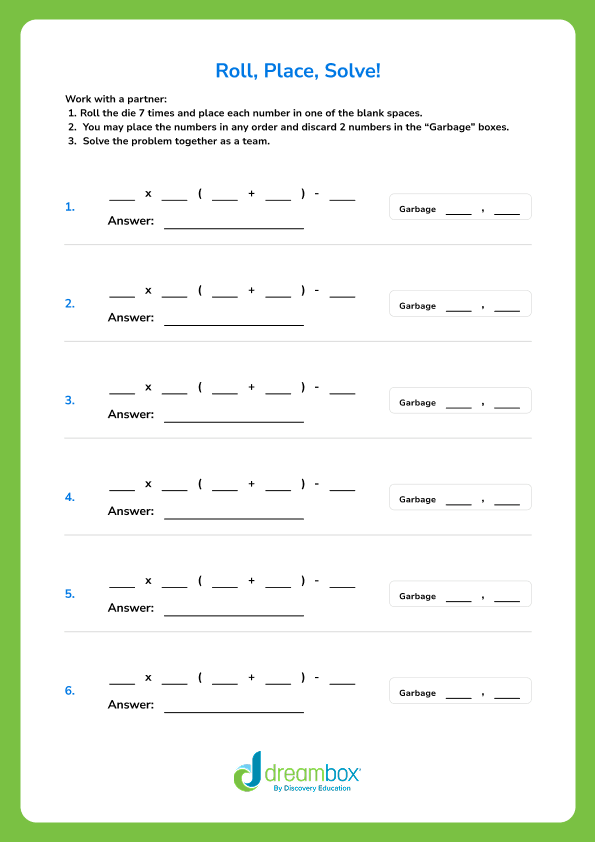
Each pair rolls the die 7 times and places the number into one of the blank spots in any order they choose. They can discard two numbers. Working together, solve the problem as a team.
Optional Support:
- Create a recording sheet with fewer spaces and operations
- Color-code each operation on the recording sheet and provide the same color-coded PEMDAS reference card to each pair.
- Create a checklist of steps
- Pull a small group that needs extra help
Optional Challenge:
- Give students a “target number” on each problem. Challenge them to arrange their numbers to get as close to the target as they can.
Exit Ticket
With 5 minutes left in the lesson, assign students an exit ticket to assess their level of understanding. Pass out an index card with a problem like this:
(5 x 6) – 4 + 2
Or, the exit ticket might have a word problem:
Natalie is trying to solve (5 x 6) – 4 + 2
She solves the problem in the parentheses first, then solves the addition problem. Is this the correct next step? Why or why not?
Reflection for Order of Operations Lesson
- What went well? How do I know?
- What evidence do I have that students meet the learning objectives?
- What would I change?
- Was the activity too simple or too complex?
- What surprised me?
- Were the students engaged? Why or why not?
- Did I adjust instruction for different learners?
- Was the pacing too fast/too slow?

The math program that drives results
Get started today!
DreamBox adapts to your child’s level and learning needs, ensuring they are appropriately challenged and get confidence-building wins.
About the Author
Katie Wickliff
Katie holds a master’s degree in Education, has over 15 years of education experience as a primary classroom teacher, and is Orton-Gillingham certified tutor. Most importantly, Katie is the mother of two primary school students, ages 8 and 11. She is passionate about maths education and firmly believes that the right tools and support will help every student reach their full potential.