Number Reversal in Children: Why It Happens and How to Help
Why Kids Write Numbers Backwards and What You Can Do About It

Author
Katie Wickliff

Published:
Aug 2026
Key takeaways
- • Young children often write numbers backward when learning correct number formation
- • Number reversals are often a typical part of childhood development, but can signify learning disabilities in older children
- • Many multisensory strategies help teach correct number formation, orientation, and other early math skills
Beginning as young as 3 or 4, students begin to develop the important skills needed to write numbers correctly. Because of this, many parents and caregivers become concerned when their children write these numbers backwards or upside down, especially if it happens often. In most cases, however, number reversals are a completely normal part of early childhood development. In this article, you’ll learn what number reversals are, why young children often reverse numbers, and when these reversals might actually signify a learning disability. You’ll also learn fun, multi-sensory strategies to help students practice correct number formation. Let’s get started!
What Is Number Reversal?
Number reversals are when a person writes letters backwards (mirror writing), switches two digits around (transposes), or writes the numbers upside down (inversion). These reversals are common in young children and may only occur with numbers or with letters as well.
What Numbers Are Most Commonly Reversed?
Some numbers are more commonly reversed, transposed, or inverted than others. While there are many reasons for this, the main reason is often because young children initially focus more on the overall shape of a number.
The numbers that are most commonly reversed are:
- 2 and 5: both numerals have similar curves
- 3 and 3 (E) –this is the most common, with up to 60 percent of children under the age of 5 reversing the numeral.
- 6 and 9: these numbers have the same basic shape and differ only by which way they are turned
- 7: young children are still learning left-to-right orientation and the simple shape of 7 makes it easy to accidently “mirror write” its image.
- Transposing numbers happens the most often with the “teen” numbers, often because these numbers don’t follow the same pattern as numbers greater than 20. For example, 14 is pronounced “four-teen.” Even though the 4 in 14 is in the tens place, the way it is pronounced makes it sound like it should be in the ones place.
Table of contents
Strengthen your math skills with DreamBox
Turn math into playtime with DreamBox Math
DREAMBOX MATH
Get started for FREE today!
Why Do Kids Write Numbers Backwards? Is it Normal?
Many young children reverse their numbers, and it usually isn’t cause for concern. As adults, we often take writing numbers correctly for granted, but the process actually requires multiple skills that take time to develop:
Visual-Spatial
Children under age 8 are still developing visual-spatial awareness, or the ability to understand position, direction, orientation, size, distance, and more. In other words,
Working Memory
Working memory is the ability to temporarily hold and work with information, allowing us to follow directions, remember what we just read, or solve a multi-step math problem. As working memory continues to strengthen, a child’s ability to store this type of information improves.
Processing Speed
Processing speed is how quickly the brain can take in, make sense of, and respond to information. Because processing speed is still developing, children might reverse numbers when writing quickly, simply because their brain has not had time to fully absorb the information.
Is Number Reversal a Sign of Dyslexia or Dyscalculia?
While number reversal can be a sign of dyslexia, dyscalculia, or other learning disabilities, it is often a typical part of early childhood development. Once kids are about 7 years old, usually in 2nd grade, and have developed in these areas, number reversals often disappear. At this stage, a child’s brain has matured visual recognition and motor patterns, making correct number formation more automatic. If a child is older than 7 and is still struggling with reversals, along with other difficulties in writing, reading, spelling, or following multi-step directions, they may benefit from a professional evaluation. These assessments can identify whether a child has a specific learning difference and needs additional support.

The math program that drives results
Get started today!
DreamBox adapts to your child’s level and learning needs, ensuring they are appropriately challenged and get confidence-building wins.
How to Help a Child with Number Reversals
Multisensory Strategies for Correct Number Formation
Multisensory strategies use visual, auditory, and movement based strategies to help children practice correct number formation. Here are some ideas that can turn writing practice into an enjoyable experience.
- Use number cards for sand writing: children use these visual models as a guide, tracing the number first with their finger and then forming the numbers on a sand tray. I used these sandpaper cards with students and my own young children.
- Spray shaving cream on the tub or shower walls and practice writing during bathtime. For a delicious option, spread whipped cream on a baking sheet!
- Using magnetic number tiles, ask children to identify a certain numeral, place it on a magnet board, and then write the number on a piece of paper alongside.
- Encourage your child to use large, exaggerated movements to “sky write” numbers in the air.
- Use modeling clay or Play-Doh to form correct numbers
- Practice repetition with number formation rhymes, poems, and stories. The rhythm will help keep children’s attention as they trace the numerals with pencil, crayons, or markers.
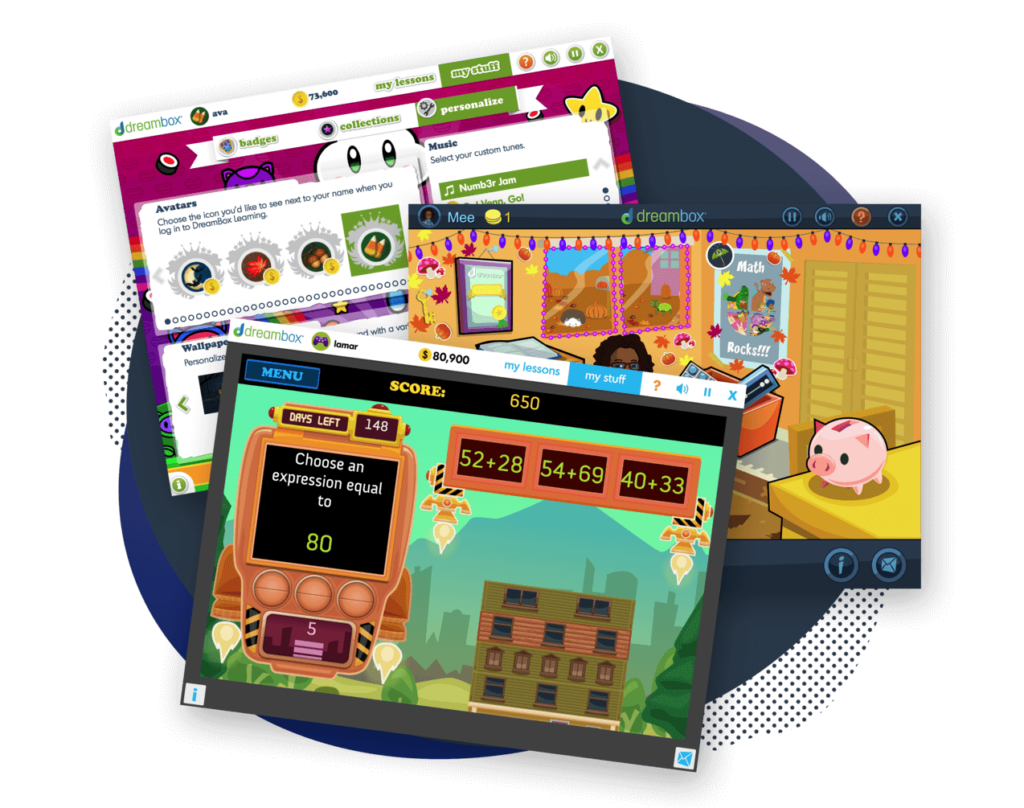
In addition to correct number formation, young children need strong number sense and counting skills. Dreambox Math helps students develop the skills they need to become confident, capable mathematicians.
Take at home math practice to the next level
Empowering parents and educators to make math practice more impactful. Plus, your kids will love it.