How to Teach Multiplication to Struggling Students
Why Students Struggle with Multiplication and How to Teach It So It Actually Sticks

Author
Katie Wickliff

Published:
Aug 2026
Key takeaways
- • Students who struggle with multiplication often have gaps in foundational math skills
- • Memorizing facts is often hard for students who do not understand the concepts behind multiplication
- • All students benefit from consistent, focused practice that builds multiplication fluency
Developing a strong understanding of multiplication is essential to become a strong, confident mathematician. Along with addition and subtraction, multiplication builds the foundation for more advanced math concepts students learn in later grades, such as calculating fractions, percentages, and algebraic equations. However, many students struggle to learn multiplication for several reasons.
Some students may have learning disabilities, such as dyscalculia, that create unique challenges. Students with suspected learning disabilities may benefit from a professional evaluation to identify their learning needs and provide appropriate supports. For our purposes, this article focuses on why students without learning disabilities struggle with multiplication. We’ll also discuss how to build a strong foundation, explore key multiplication concepts, and provide some quick tips and tricks students can use if they feel stuck.
Why Do Students Struggle with Multiplication?
Students struggle with multiplication for a variety of reasons. Some students may have difficulty in one area; others in several, so identifying why an individual student is struggling is essential. Let’s break down some of the most common reasons:
They Lack a Strong Foundation
Students with weak addition and subtraction skills often have a hard time visualizing multiplication as equal groups. Students should have a firm grasp of addition and subtraction before starting multiplication, because multiplication builds on that knowledge, allowing students to see patterns, understand how numbers relate, and recognize groups.
They Have Underdeveloped Number Sense
Students with strong number sensecan confidently work with numbers, develop efficient strategies, flexible thinking skills, and the confidence needed to tackle more complex problems later on. However, many struggling students have not yet fully developed number sense, which makes it difficult for them to understand mathematical concepts.
They Experience Math Anxiety
Many students experience math anxiety, which can significantly impact their performance. They may dread going to class and feel overwhelmed by a page full of timed problems that they are supposed to answer quickly. This anxiety is a real emotional and physical response that can inhibit learning and performance.
They Are Introduced to Abstract Thinking Too Soon
Expecting students to solve problems using abstract thinking, i.e., a multiplication algorithm, can also cause difficulty if students aren’t ready. As with any math concept, the most effective strategy is to teach conceptual understanding through manipulatives (physical objects) and visual models before expecting students to solve problems with abstract thinking.
The Problem with Rote Memorization
Rote learning is the process of using repetition to memorize information. While rote memorization is deeply ingrained in many educational systems, it is often an ineffective way for students to learn multiplication. In multiplication, rote memorization looks like having students memorize facts without understanding relationships between numbers. Because rote memorization emphasizes recall, not comprehension, students have difficulty thinking critically to apply their knowledge to new situations or real world problems. Also, many students simply struggle to memorize multiplication facts and need effective strategies to build both fluency and confidence.
Table of contents
Strengthen your math skills with DreamBox
Turn math into playtime with DreamBox Math
DREAMBOX MATH
Get started for FREE today!
How to Teach Multiplication to Struggling Students
Building strong multiplication skills starts with ensuring students have a firm grasp of the basic concepts that form the building blocks of multiplication. CRA, or the concrete-representational-abstract method, helps students transition from using physical objects to visual representations and ultimately to abstract reasoning to solve problems. This approach helps students develop conceptual understanding before moving on to abstract equations and procedures.
Build Understanding with Equal Groups, Arrays, and Repeated Addition
Forming equal groups with physical objects like counters, blocks, or coins is a concrete way for young students to understand that multiplication involves making groups and that repeated addition can find the total. For example, put three coins on three plates and have students count the total. (3+3+3=9). Then explain that multiplication is another way to represent the same idea: 3 groups of 3 equals 9, so 3×3=9. Plenty of hands-on practice will help students feel confident creating and counting equal groups.

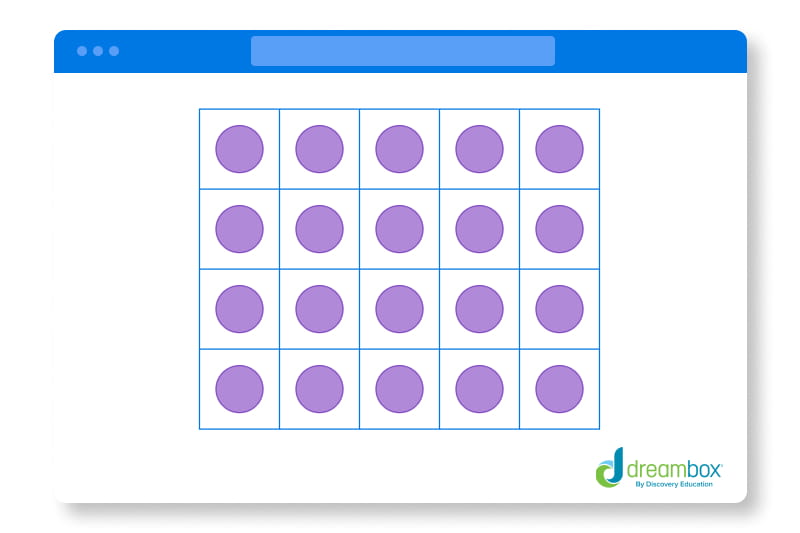
Arrays show multiplication by arranging items into structured rows and columns. They provide an organized way for students to clearly visualize equal groups and other important concepts, such as the commutative property. For example, an array with four rows of five columns shows 4×5, while turning the array shows 5×4, allowing students to see that both equations have the same product.
Use Skip Counting
To reinforce equal groups and repeated addition, teach students how to skip count both forward and backward. Skip counting can be especially helpful if students are having trouble seeing equal groups and are still counting by 1s to reach the total. Using skip counting also helps students begin to see patterns. Try chanting, stomping, and clapping in rhythm while you skip count. In addition to being fun, it actually helps make number sequences automatic. Pair skip counting with physical objects to increase comprehension and memory. When students can skip count using physical objects, move on to visual methods like hundreds charts and number lines.
Teach “Easy” Facts First
Begin teaching facts with simple, predictable patterns, such as 0, 1, 2, 5, and 10. This can help struggling students feel more confident, successful, and ready for the next challenge. Remember to use physical objects, visual models, or movement-based instruction, even with these “easy” facts:
- 0s: any number times 0 is 0, even the biggest numbers!
- 1s: any number times 1 is always 1.
- 2s (doubles): any number times 2 is always just doubling the number, and students can easily see how this ties to addition. For example, 7+7=14, so 2 groups of 7 are 14, and 2×7=14
- 5s: any number times 5 always ends in a 0 or 5
- 10s: add a zero to the number to get your answer. 10 x 8 = 80.
Teach the Commutative Property (so students feel less overwhelmed)
Students are usually excited to learn that the commutative property halves the number of facts they need to memorize! Show how any multiplication problem can be switched around and still get the same answer. For example, 3×4= 12 is the same as 4×3=12. Making sure students understand this property will help them feel less overwhelmed.
Build on Prior Knowledge
Once students are comfortable with these easy facts, show them how to use those facts as stepping stones to tackle harder problems. For example, when solving a harder problem like 6×3, they can call upon their knowledge of doubles, 6×2 = 12 and then add another group of 6 to reach 6×3=18. Again, this “stepping stone” method helps kids easily see the relationship between addition and multiplication.
Although these may seem like just simple “tricks,” they actually help develop pattern recognition and deepen comprehension.
The math program that drives results
Get started today!
DreamBox adapts to your child’s level and learning needs, ensuring they are appropriately challenged and get confidence-building wins.
Support Struggling Students With Consistent Daily Practice
While learning multiplication through rote memorization may come easily to some, struggling students need other practice strategies to build their knowledge and confidence. Many activities encourage children to practice important concepts through hands-on learning, making math more enjoyable and easier to understand. Here are a few my students loved:
Turn Arrays into Art
Turning arrays into classroom art allows students to practice multiplication both individually and as a whole group. To begin, each student receives a piece of grid paper along with pencils, markers, or crayons. Students will draw several buildings by making vertical rectangles of different sizes. Next, they color in window squares on each building to create arrays with equal rows and columns. Students can create their own arrays, or you can provide guidelines. At the base of each building, students write arrays as a multiplication equation, repeated addition, and a statement showing equal groups, such as “4 equal groups of 5.” When everyone has finished, connect the buildings to create a colorful classroom city skyline. This activity can be easily differentiated; for example, one student may be mastering their 3 times tables while others are on their 7s.
Guess Who? Multiplication
Divide the students into pairs and give each pair a deck of shuffled multiplication cards, face down. To begin, one partner draws a card. Without looking at it, he places the card on his forehead, face out so his partner can see it, for example, “6 x 4.” The partner calls out the product “24” but does not reveal the equation. The first partner guesses the possible factor pairs “8 x 3?” “12×2?” etc. until they call out the right one. Then they switch spots. To keep this low pressure, partners can help one another if they get stuck. This reinforces factor pairs and flexible thinking.
Online Games
Research has found that students are more engaged in their learning when they play games that encourage experimentation and exploration. Games are especially appealing for students struggling with multiplication because they alleviate the pressure of traditional grades. Repetition just doesn’t seem as much of a chore when in a game context. Dreambox Math is an interactive online math program that makes learning multiplication feel more manageable. With personalized learning plans tailored to each student’s unique needs, Dreambox Math is perfect for struggling learners who want to take things at their own pace.
Take at home math practice to the next level
Empowering parents and educators to make math practice more impactful. Plus, your kids will love it.