4th Grade Math Lesson Plan
Elevate your 4th grade math instruction with this comprehensive lesson plan on comparing decimal place values.

Author
Katie Wickliff

Published:
March 2026
Key takeaways
- • In 4th grade, students extend their place value knowledge to include decimals
- • Connecting decimals to real-world situations helps students understand their importance and relevance in everyday life.
- • Strong decimal lesson plans should include a purposeful instruction, guided practice, and independent work.
When students enter 4th grade, they are already familiar with the place value of whole numbers. They have also been introduced to decimals and their relationship to fractions. With this foundation, students are ready to extend their place value understanding to include places to the right of the decimal. This complete sample lesson focuses on comparing two decimals to the hundredths place and connects decimals to the real world through money word problems. Throughout the lesson, students have several opportunities to demonstrate their knowledge. Let’s get started!
Sample Place Value of Decimals Lesson Plan
Lesson Objectives
The learning objectives for this lesson are based on S.M.A.R.T. goal setting criteria:
Specific
Students will write decimal numbers, identify the value of digits in the tenths and hundredths places, and compare two decimals to the hundredths place using real-world money problems.
Measurable
Students will accurately identify the value of digits in a decimal number and compare decimals using greater than, less than, or equal to symbols (>, <, =). Students will demonstrate at least 80% accuracy on an exit ticket and recording sheet.
Achievable
Fourth grade students have already mastered place value concepts for whole numbers, have experience with fractions, and have learned the connection between fractions and decimals. They have also been introduced to decimal numbers in the tenths and hundredths places, including using decimals to represent money amounts.
Relevant
This lesson aligns with Common Core 4th Grade Mathematics Standards: Numbers & Operations: Fractions (Compare two decimals to hundredths).
Time Bound
By the end of this 60-minute lesson, students will demonstrate understanding through self-assessment, active group participation, and accurate completion of written work.
Assessment
Formative assessments throughout the lesson include turn and talk, whole class and group participation, and a submitted recording sheet and exit ticket.
Materials Needed
- Coins or coin manipulatives
- 5 index cards per student for partner activity
- Recording sheet (with place value chart; see example)
- 1 extra index card for exit ticket
Table of contents
Strengthen your math skills with DreamBox
Lesson Procedure
Hook/Introduction
Begin with a quick place value review– whole numbers and decimals. On the board write any whole number, such as: 7 3 5
Ask questions like:
- Can someone read this number aloud?
- What is the value of the 3?
- Is this a whole number or a decimal number?
- How can I make this a decimal number?
To answer the last question, have a volunteer come up and place a decimal point anywhere in the number. For example, if the student changes the number to 7.35. Then draw a quick place value chart around the number, like this:
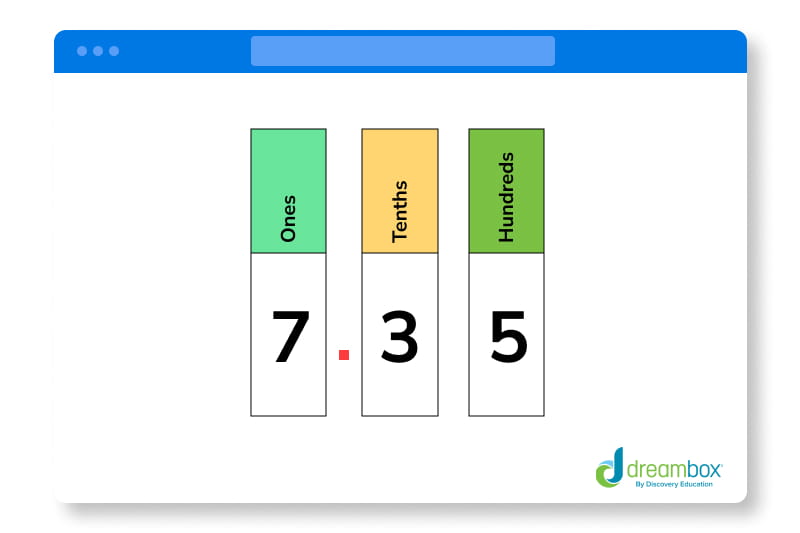
Ask questions like:
- What number is in the ones place?
- Tenths place?
- Hundredths place?
Learning Activities
Direct Instruction
To introduce the activity, ask:
- Where is somewhere we often see decimal numbers in real life?
Have students turn and talk to their “elbow partner” and then share their answers with the class. Tell students that decimal numbers are common when working with money, and accurately comparing amounts determines which amount is larger than another.
Write a simple word problem on the board, such as:
- If Jordan has 2.35 cents from his allowance and Sam has 2.36 cents from his allowance, who has more money? How do we know?
Write each decimal number on the place value chart on the board and model your thinking step by step, then write the answer on the board:
- 2.36 > 2.35
Sam has more money.
Using the money manipulatives, show students how you would make each number using coins and bills.
Before moving to guided and independent practice, make sure to address any confusion.
Ask questions like:
- Which place value should we look at first when comparing decimal numbers, and why?
- If the numbers in the ones and tenths places are the same, what place value do we compare next?
- If the question asked who has LESS money, how could we write the answer (2.35 < 2.36)
Guided Practice
- Guide the class through another word problem, asking for student input at each step. Then, have students work through one last example with a partner, recording their answer on a whiteboard or paper and sharing with the whole class. Observe which pairs accurately solve the problem and which might need more support.
Independent/Small Group Work
Pass five index cards out to each student, one place value recording sheet per pair, and a blank piece of paper for answers. Instruct students to write a decimal on each card– numbers may have up to two digits after the decimal point and one digit before the decimal point. Each card must be different. To ensure fairness, do not tell the students the purpose of the cards until everyone has finished.
Then, partners play “war” using their cards. The players hold their cards face down and then flips over one card at the same time. The person who played the card with the greater value wins the round. After each flip, partners record their decimal comparisons on paper, using the place value recording sheet for extra support when needed.
When time is up, partners must represent one of their comparisons using bills and coins. Either circulate to check for accuracy or have pairs share with the class.
Optional Support:
- Encourage students to use the place value template instead of blank paper to represent their comparisons
- Pair a student with a stronger understanding of place value with a student who needs extra practice
Optional Challenge:
- Add blank cards to the “war” challenge game
- Invite student pairs to represent more than one comparison using bills and coins
- Ask students to create their own money word problem based on their decimal cards
For additional place value support or enrichment, head over to Dreambox Math, an interactive online program that helps students strengthen math skills through activities tailored to their individual level.
Exit Ticket
With 5 minutes left in the lesson, assign students an exit ticket to demonstrate decimal place value and comparison understanding. Pass out an index card with a quick word problem, like this:
“Jessa and Taylor buy items at the store. Jessa receives $5.82 in change. Taylor receives $5.20 in change. Who receives more change? Write a decimal comparison using greater than, less than, or equal to symbols.”
Reflection for Decimal Place Value Lesson
- What went well? How do I know?
- What evidence do I have that students met the learning objectives?
- Were the students engaged? Why or why not?
- Did I adjust instruction and complexity for different learners?
- Was the pacing too fast/too slow? Was any portion of the lesson (direct instruction, guided practice, independent work) too long?
The math program that drives results
Get started today!
DreamBox adapts to your child’s level and learning needs, ensuring they are appropriately challenged and get confidence-building wins.
About the Author
Katie Wickliff
Katie holds a master’s degree in Education, has over 15 years of education experience as a primary classroom teacher, and is Orton-Gillingham certified tutor. Most importantly, Katie is the mother of two primary school students, ages 8 and 11. She is passionate about maths education and firmly believes that the right tools and support will help every student reach their full potential.