Math Fact Fluency
A clear, easy-to-follow guide to strengthening math fact fluency with techniques that actually work for students of all ages.

Author
Tess Loucka

Published:
December 2025
Key takeaways
- • Math facts are addition, subtraction, multiplication, and division problems that combine two single-digit numbers.
- • Most educators expect students to know math facts up to 20 + 20, 20 - 20, 12 x 12, and 12 ÷ 12, but not all educators are the same.
- • Students don’t have to memorize every single math fact if they understand number connections, foundational math rules and properties, and use the derived facts strategy.
If you’ve ever wished you were faster at math, improving your math fact fluency is the answer.
Math fact fluency is the same as fluency in a language—it makes recalling important information quick and easy on the brain, saving more mental energy for the tougher stuff.
But you can’t have math fact fluency if you don’t know what math facts are! So, let’s define math facts and talk about how you can build math fact fluency fast and effectively.
What are math facts?
So, what are math facts? Math facts are the simple, one-digit combinations of numbers using the four basic operations: addition, subtraction, multiplication, and division.
5 + 9 = 14 is a math fact.
7 x 3 = 21 is also a math fact.
Generally, students should be able to mentally compute addition and subtraction problems up to 20. They should be able to compute multiplication and division problems up to 12 just as easily.
What exactly does that mean?
Take a look at the charts below to see exactly what math facts you should know to make mental math a breeze.
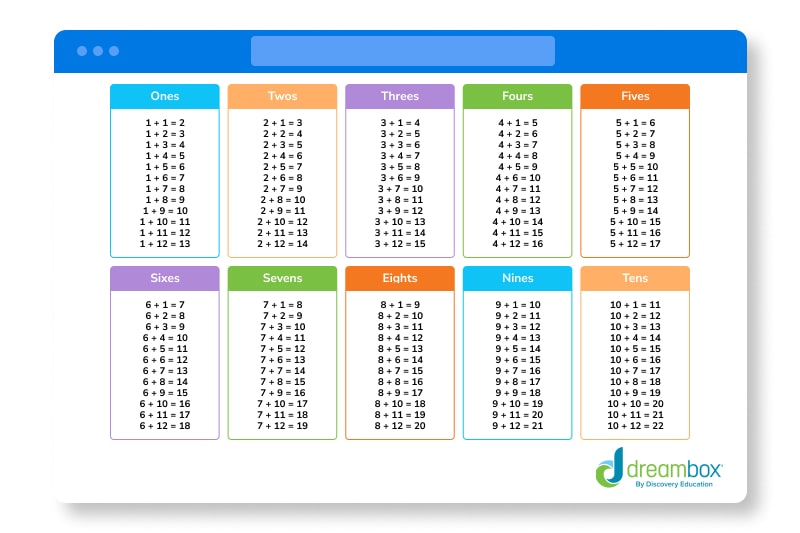
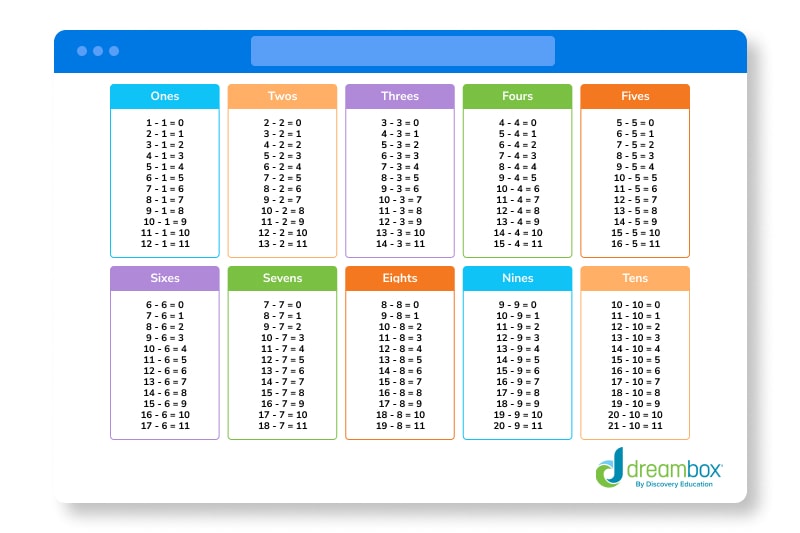

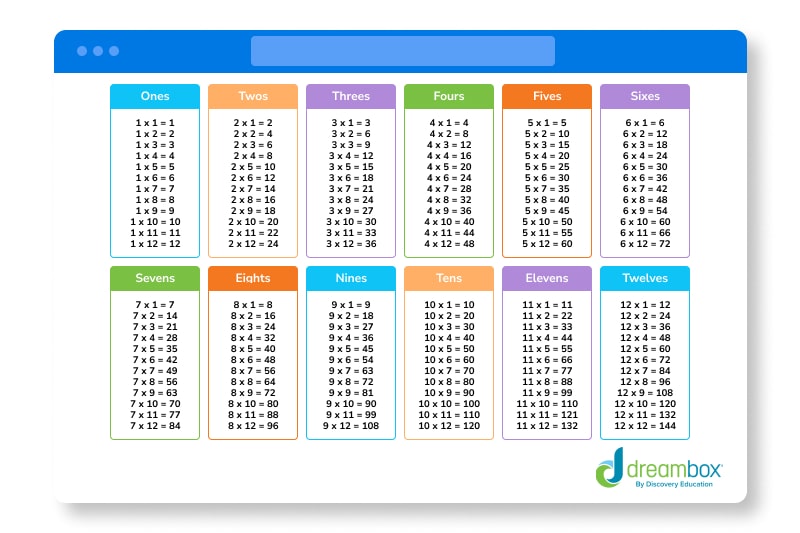
In total, there are close to 450 math facts that students should know off the top of their heads. That’s a lot!
If you try to memorize them all, you’re likely to forget them in a few days. But once you understand the patterns behind math facts, you’ll remember them for life.
Let’s go over the simple tricks students can use to understand the patterns behind these math facts and ultimately memorize them, making math quicker and easier.
How do you build math fact fluency?
Teachers all over the world have their own methods for improving their students’ math fact fluency. But no matter if you’re an elementary school teacher, a university professor, a student, or a stay-at-home parent trying to help their child succeed, there are eight techniques everyone can agree on.
1. Define your math facts
Different teachers expect students to know different ranges of math facts. For instance, some schools might ask students to memorize multiplication facts from 0 x 0 = 0 up to 20 x 20 = 400. Meanwhile, other schools may only teach up to 10 x 10 = 100 or 12 x 12 = 144.
That’s why, when setting study goals for students, it’s important to first clarify what exactly they’re expected to know.
2. Display math facts
Once the math facts have been defined, it’s best to display them where students can see them every day. You can purchase or make math fact posters and hang them up on the classroom wall, or you can make a math facts printout and ask your students to keep them in their folders.
The more students look at math facts, the faster they will notice patterns and make connections, making fact recall much easier.
3. Turn math facts into a song
Most people learn the ABCs and state capitals through fun, simple songs, and math facts are no different!
The most common math fact songs help students memorize multiples of single-digit numbers. For instance, multiples of 3 up to 30 can be sung to the tune of “I Love You” from Barney & Friends.
Multiples of 4 up to 40 can be sung to the tune of “Bingo.”
Multiples of 6 up to 60 fit well into the tune of “Twinkle, Twinkle, Little Star.”
And multiples of 7 up to 70 can be sung to the tune of “Baby Beluga.”
Memorizing just those four math fact songs can help students solve 40 multiplication facts and 40 division facts. That’s 80 facts from four nursery rhymes!
So, look up some catchy math fact songs or create your own to teach your students their addition, subtraction, multiplication, and division facts through music.
4. Understand number connections
There are dozens of number connections that make memorizing math facts easier. The most important are:
- Adding to 10
The combination of specific single-digit numbers will always equal 10: 1 + 9, 2 + 8, 3 + 7, 4 + 6, and 5 + 5.
- Doubles
The double of each single-digit number is always important to know, and helps with both addition and multiplication.
- Fact families
Any group of three single-digit numbers can create four different facts. For instance, the numbers 2, 8, and 6 create the fact family 2 + 6 = 8, 6 + 2 = 8, 8 – 6 = 2, and 8 – 2 = 6.
5. Use the derived facts strategy
Derived facts are math facts that can be derived, or figured out, based on their association with or proximity to other facts.
For example, if asked to solve 5 x 6, you may not know the answer off the top of your head. But if you already know that 5 x 5 = 25, then solving 5 x 6 is easy! Just add another 5 to 25 to get 30.
The derived facts strategy eliminates the need to memorize every math fact, making the mental load lighter for students.
6. Explain foundational rules and properties
Math exists because of specific properties and foundational rules of numbers that are always true. Luckily for us, many of those properties and rules can help students understand and memorize math facts.
One basic math rule is that a number plus or minus 0 will always equal the number. For instance, 5 + 0 = 5 and 5 – 0 = 5.
Also, a number multiplied by 0 will always equal 0—8 x 0 = 0—and a number multiplied or divided by 1 will always equal the number—3 x 1 = 3 and 3 ÷ 1 = 3.
On the topic of properties, it’s always important to know the commutative property, which states that the order of numbers being added or multiplied does not matter; the answer will always be the same. That means, 5 x 3 = 3 x 5 and 5 + 3 = 3 + 5.
These simple math rules may seem confusing to students at first, but they need to grasp these concepts before attempting to memorize math facts. After all, memorization without understanding is not the goal.
7. Practice skip counting
Skip counting is the first step students can take toward understanding multiplication. The ability to skip count every single-digit number up to a multiple of 10 will make memorizing multiplication and division math facts effortless.
8. Practice every day
A student can’t learn every math fact in a day, but they can learn them all over time with consistent, structured learning. Use worksheets, do classroom activities, have fun competitions, or play math games on websites or math apps to improve math fact fluency in a way that’s engaging and exciting.
Table of contents
Get help with math with DreamBox!
Start Your Free Trial
See how DreamBox can help with math by signing up for a free trial today.
About the Author
Tess Loucka
Tess Loucka discovered her passion for writing in high school and has not stopped writing since. Combined with her love of numbers, she became a math and English tutor, focusing on middle- and high-school-level topics. Since graduating from Hunter College, her goal has been to use her writing to spread knowledge and the joy of learning to readers of all ages.
Take at home math practice to the next level
Empowering parents and educators to make math practice more impactful. Plus, your kids will love it.