Two-Step Word Problems: What They Are and How to Solve Them
Two-Step Word Problems Explained: Types, Examples, Step-by-Step Solving, and Teaching Strategies

Author
Katie Wickliff

Published:
Aug 2026
Key takeaways
- • Two-step word problems must be solved in two separate steps.
- • Students are usually introduced to two-step word problems in 2nd grade and continue working with them in 3rd grade.
- • Common mistakes when solving two-step word problems include forgetting to include a unit in an answer, using the wrong operations when solving, and forgetting to double-check work.
Table of contents
Strengthen your math skills with DreamBox
What Are Two-Step Word Problems?
Two-step word problems are word problems that take two steps to get the answer. Often this means using two operations or equations.
Word problems can be tricky for students of any age, and two-step word problems can be especially challenging.
So, let’s go over how two-step word problems work and the step-by-step instructions for solving them.
Two-Step vs. One-Step Word Problems
One-step word problems ask only one question and can be solved using only one operation or equation. Take the following two-step word problems examples:
Marianne is painting a fence. The fence is 25 feet long, and she has already painted 18 feet of it. How many feet of the fence does she still have to paint?[b]
This problem can be solved in one step: 25 – 18 = 7, so there are 7 ft left.
Two-step word problems must be solved in two steps. For example:
There are 15 kids at the playground in the morning. By the afternoon, 10 more kids come, but 8 leave. How many kids were there at the playground in total in the afternoon?[c]
To solve, do 15 + 10 = 25 and 25 – 8 = 17. So, there were 17 kids in the playground in the afternoon.
Types of Two-Step Word Problems
Not every two-step word problem is the same. There are two main types to be familiar with.
Story Structure Problems
Some word problems tell a story. Story structure problems usually involve characters doing an activity. They generally describe real-life scenarios and follow a narrative structure.
Let’s look at the following example:
Amy and Dillan are baking cookies at Amy’s house. Amy has two cookie trays, and each tray can hold 18 cookies. If they end up making 33 cookies, will there be enough room on the trays for them?[d]
In this problem, the characters (Amy and Dillan) are involved in a realistic scenario (baking cookies).
The question you have to answer will help solve a problem the characters are facing.
To solve this, calculate how many cookies the trays can hold in total: 18 + 18 = 36. Then, determine if there is enough room on the trays for 33 cookies: 36 – 33 = 3. So, yes, there is room for the cookies.
Part-Part-Whole Structure Problems
Part-part whole word problems usually center around an object or collection of objects and aim to teach students the relationship between the parts of an object and the whole.
For instance:
There are 12 pizzas at a pizzeria. Two of them are plain, and the rest are pepperoni. If 5 pepperoni pizzas get sold, how many pepperoni pizzas will there be left?[e]
The “whole” in this example would be the 12 pizzas. The two “parts” would be the plain pizzas and the pepperoni pizzas.
To solve, first determine how many pepperoni pizzas there are: 12 – 2 = 10 pepperoni pizzas.
Then, find the total remaining pepperoni pizzas after 5 are sold: 10 – 5 = 5.
Turn math into playtime with DreamBox Math
DREAMBOX MATH
Get started for FREE today!

When Do Students Learn Two-Step Word Problems?
Students start learning multi-step word problems when they’re around 7 and 8 years old. Two-step word problems 2nd grade classes teach keep things basic, focusing on addition and subtraction of one- and two-digit numbers.
Two-step word problems 3rd grade classes teach may include multiplication and division and involve larger numbers.
How to Solve a Two-Step Word Problem Step by Step
The first step when learning how to solve two-step word problems is, of course, to read it! Students can make this step more effective by annotating as they read, circling key words, underlining important information, and crossing out anything extra.
While reading, ask yourself:
What is being asked?
What exactly is the question asking you to find? Is it a digit? A measurement? Is it asking for a “yes” or “no”?
What is the first operation?
Two-step word problems tend to include two operations. So, go through the text and figure out what the first operation is. Pay attention to key words:
Addition & Subtraction Keywords
| Addition | Subtraction |
|---|---|
| Add | Fewer |
| More | Remaining |
| Sum | Less |
| Plus | Difference |
| In addition | Decrease |
| Increase | Minus |
| Combine | Change |
| Altogether | Take away |
Multiplication & Division Keywords
| Multiplication | Division |
|---|---|
| Times | Shared |
| Groups of | Equal parts |
| Product | Per |
| Multiplied by | Split |
| Doubled | Into groups |
| Sets of | Evenly |
Writing Equations for Each Step
Solving two-step word problems means writing out two separate, yet related equations.
To write an equation, you need two values and an operator, all of which you can find in the word problem itself.
How might we write out an equation for the following sentences?
- There were 9 apples, and 5 were taken away → 9 – 5 = 4 apples
- Austin had 15 pencils, then bought 10 more → 15 + 10 = 25 pencils
Checking Your Answer for Reasonableness
The last step when solving any word problem is to check that your answer makes sense. Does the answer you got correlate to what the question is asking?
If there’s time, go through the problem line by line and compare it with your equations. Do they look right? And did you solve the equations correctly?

The math program that drives results
Get started today!
DreamBox adapts to your child’s level and learning needs, ensuring they are appropriately challenged and get confidence-building wins.
How to Teach Two-Step Word Problems in the Classroom
First things first—students must understand what the two different types of two-step word problems are.
Depending on whether the word problem is written using story structure or part-part-whole structure, certain two-step word problems strategies can be used to make answering easier and more efficient.
When faced with a two-step story problem, look out for values and key words. Then, write out the two related equations and solve them to find the answer.
For part-part-whole two-step word problems, figure out what values represent the “whole” and both “parts.” You can write these values in a grid like this:
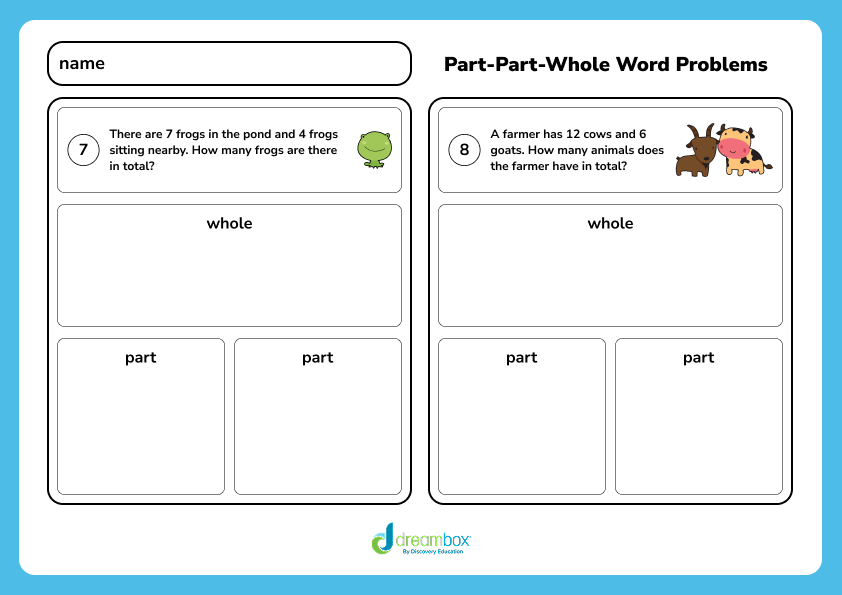
Then, determine what the appropriate operations are, write out your equations, and solve!
Using Visual Models, Diagrams, and Manipulatives
It’s hard for elementary-age children to visualize math concepts in their heads. Finding ways to bring those concepts into reality, using models, diagrams, or physical manipulatives, can make a big difference!
So, when solving word problems with students, don’t just use numbers—use images and objects too! If a word problem mentions “8 bottles of water,” use real bottles of water (or counters, coins, cards, etc.) as manipulatives.
Other problems might be better visualized using Venn diagrams, strip diagrams, or tape diagrams that demonstrate how numbers combine or take away from each other to create other values.
When word problems seem too abstract, making them tangible with physical objects is often the key to success for young students.
Common Mistakes Students Make with Two-Step Word Problems
Even if a student knows what steps to take when solving two-step word problems, mistakes always happen. These are the most common mistakes students make when solving two-step word problems:
Using the wrong operations
If students don’t have a strong understanding of operation keywords, it’s easy to mix up division with subtraction, multiplication with addition, and otherwise struggle to use the correct operations when solving. Also, students should get into the habit of annotating word problems as they read them through.
Ignoring units
On exams, writing down an answer without using the correct unit often results in points being taken away. So, don’t forget to include it!
If it helps, students can circle the unit in the word problem before they start to solve it as a helpful reminder to include it in their answer.
Not double-checking their work
Students should always double-check their answers. There may not be time to go through the entire problem again, but it’s important to take a moment to 1) check your calculations to make sure there are no silly mistakes, and 2) check that the answer is reasonable.
Think: does this answer make sense?
For instance, if you’re asked to find how many students there are in a classroom, an answer of 2.5 wouldn’t make sense, because there can’t be half of a student!
Forgetting about the second operation
Sometimes students are so happy to have solved the first part of a two-part word problem that they forget all about the second part! A quick double-check of the problem should reveal the mistake.
Two-part word problems can be confusing, and if students struggle with them, it’s okay! All they need is more practice. For more information on two-part word problems and related activities, explore online math apps, programs, and other educational material for further learning in and out of the classroom.
Take at home math practice to the next level
Empowering parents and educators to make math practice more impactful. Plus, your kids will love it.