Number Bonds in Math: What They Are and How to Teach Them
What Are Number Bonds? A Guide to Part-Part-Whole, Grade-Level Expectations, and Classroom Activities

Author
Tess Loucka

Published:
August 2026
Key takeaways
- • Number bonds are written using the part-part-whole model that takes a number and breaks it into two smaller parts.
- • When you add up the “parts” of a number bond, they will always equal the “whole.”
- • Number bonds are generally used in kindergarten through 2nd grade math and teach students about addition and subtraction while also improving their number sense and problem-solving skills.
What Are Number Bonds?
Number bonds are numbers broken down into smaller chunks. They are the “bonds” or relationships between values and help demonstrate how numbers can combine.
Learning about number bonds not only helps strengthen students’ number sense, but teaches addition and subtraction as well.
Number bonds are a simple yet essential piece of knowledge that students generally learn between the grades of kindergarten and 2nd grade. But what are number bonds, and what is the part-part-whole model?
What Is the Part-Part-Whole Model?
With the part-part-whole model, you can write number bonds out using numbers and connecting lines.
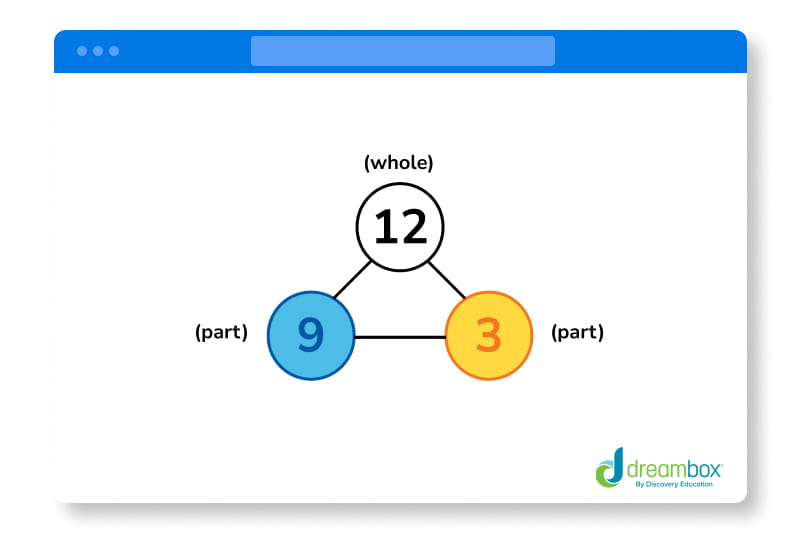
In this number bond, the whole number is 12, and the two parts are 9 and 3. This means that 9 and 3 combine to make 12.
How else could we fill in this number bond?
Instead of 9 and 3, we could write 1 and 11, 2 and 10, 4 and 8, 5 and 7, or 6 and 6.
These part part whole number bonds are an extremely useful, yet simple demonstration of breaking down numbers and better understanding them.
Why Are Number Bonds Important in Math?
Learning number bonds is an essential step in developing number sense and will help build a firm foundation for addition, subtraction, and more advanced math in later years.
Understanding number bonds means being able to look at a number and not just see a digit, but the inner workings of it. For instance, when seeing an 8, a student could immediately recognize it as 4 and 4, 5 and 3, or any of its other number bonds.
And, understanding that numbers are made up of combinations of smaller numbers puts students in the right mindset for learning about factors, fractions, decimals, and more.
Number Bonds and Addition and Subtraction Mastery
Every addition and subtraction problem can be broken down using number bonds.
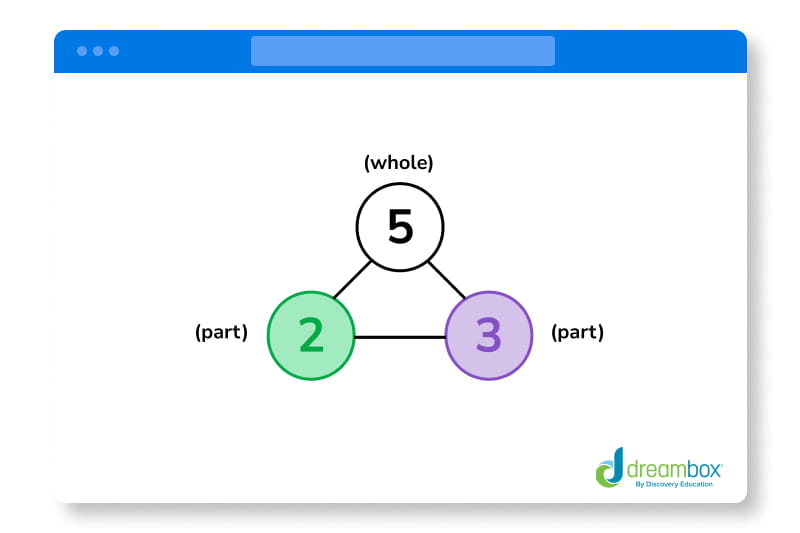
This number bond demonstrates four things:
2 + 3 = 5
3 + 2 = 5
5 – 2 = 3
5 – 3 = 2
And how about this multi-branch number bond?
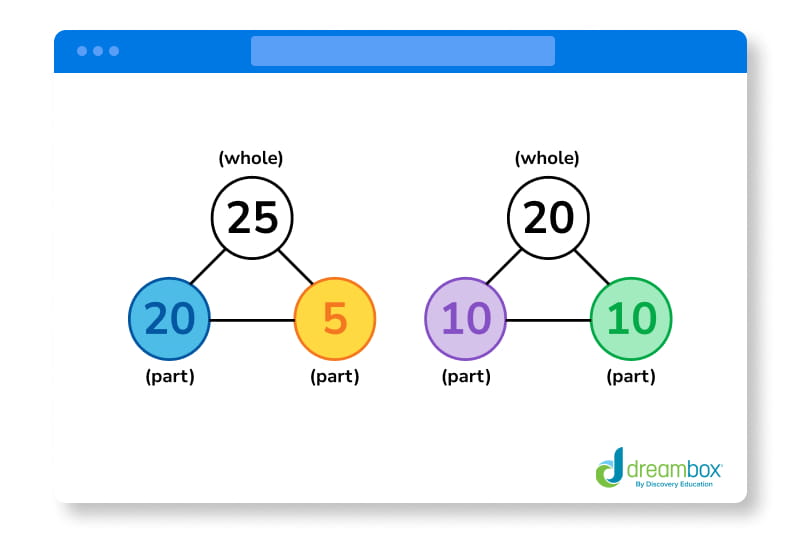
This number bond breaks a two-digit number down into three different parts. First, 25 is split into 20 and 5. Then, the 20 is split into 10 and 10.
This number bond demonstrates:
20 + 5 = 25
5 + 20 = 25
25 – 5 = 10 + 10 = 20
25 – 10 = 10 + 5 = 15
As you can see, number bonds demonstrate the ways in which numbers can combine to create new numbers! The “parts” of a number bond will always add up to the “whole,” while the “whole” minus one of its “parts” will always equal the other “part.”
Number bonds written out in this way are number bonds addition and subtraction lessons can greatly benefit from!
Number Bonds and Number Sense
Number sense is simply the ability to recognize and understand values without having to count. For instance, having number sense allows you to see two rows of 6 eggs and immediately know that there are 12 eggs in total.
Number bonds strengthen students’ number sense by taking larger numbers and breaking them down into smaller, easily recognizable pieces. For instance, breaking 8 down into 4 and 4.
Number Bonds as Building Blocks for Higher Math
Without a good number sense, or an understanding of addition and subtraction, students will struggle when they reach the upper grades.
Learning to break down large numbers into smaller chunks with number bonds not only sets students up for success in algebra, but it improves cognitive function and problem-solving skills, too.
Working with number bonds isn’t the only way young students can improve their understanding of numbers, but it’s one of the easiest and most effective!
Table of contents
Strengthen your math skills with DreamBox
Turn math into playtime with DreamBox Math
DREAMBOX MATH
Get started for FREE today!
When Do Students Learn Number Bonds in Elementary School?
Students as young as 4 years old in kindergarten can be introduced to number bonds, and they are generally used through the 2nd grade.
Number Bonds to 10 (Kindergarten)
Number bonds kindergarten-age students work on are number bonds to 10, meaning the “whole” numbers remain in the range of 2 to 10. Even if students can count higher than 10, it’s best for them to try and master their understanding of digits 1-10 before getting to 1st grade.
Number Bonds to 20 (1st Grade)
In 1st grade, students may be able to count all the way up to 100 and beyond, but the number bonds 1st graders use are number bonds to 20, where the “whole” is always less than or equal to 20.
Students may also be introduced to multi-layered number bonds, like the one from our previous example:
From this, students can see that equations can have more than two values!
Number Bonds to 100 (2nd Grade)
By the 2nd grade, most students will feel comfortable counting all the way up to 1,000—if they wanted to. But when using number bonds, the focus is generally on numbers up to 100.
With 100 as the “whole,” students can practice finding two two-digit “parts,” like 75 and 25, or they can take things a step further and attempt to break both “parts” into even smaller, single-digit numbers.
Remember, there may be dozens of ways to break down large numbers, and the more students practice making their own number bonds, the better their number sense will be.
The math program that drives results
Get started today!
DreamBox adapts to your child’s level and learning needs, ensuring they are appropriately challenged and get confidence-building wins.
How to Teach Number Bonds in the Classroom
Number bonds can make their way into your classroom in a number of fun and engaging ways. When you’re tired of worksheets, spend some time on hands-on activities and games instead!
Hands-On Number Bond Activities and Manipulatives
Looking for fun number bonds activities? Try these!
Buy or Make Number Bond Manipulatives
Manipulatives are simply objects that students can manipulate, or move around. Use manipulatives to allow your students to create 3D number bonds!
Number bond manipulative sets can be found on online marketplaces. But if you’re looking to save some money, try making your own! You can use cups or trays as the “whole” and “part” sections, and pieces of string as the connecting lines.
Students can use clay, coins, or counters to fill in the sections.
Playing card number bonds
An easy way to make number bonds more hands-on is to use playing cards! Give students a “whole” and have them choose the two “parts” using a selection of playing cards in front of them.
Remember to take out the face cards first. And explain that aces equal 1.
Blocks up to 10
Use Legos or other connecting blocks for this activity. Start by building a tower made up of 10 blocks. This will be the reference tower.
Then, build one tower each measuring 1, 2, 3, 4, 6, 7, 8, and 9 blocks. Build two towers of 5 blocks as well.
Finally, ask your student to use the pre-built towers to create five towers of 10 blocks.
They’ll need to compare tower sizes and count the blocks to create combinations of numbers that add up to 10, helping build their number sense and understanding of number bonds.
Number Bonds Fact Families and Related Facts
For all number bonds, there are number bonds fact families. A fact family is generally made up of four related equations that all use the same values.
Look at the following number bond:
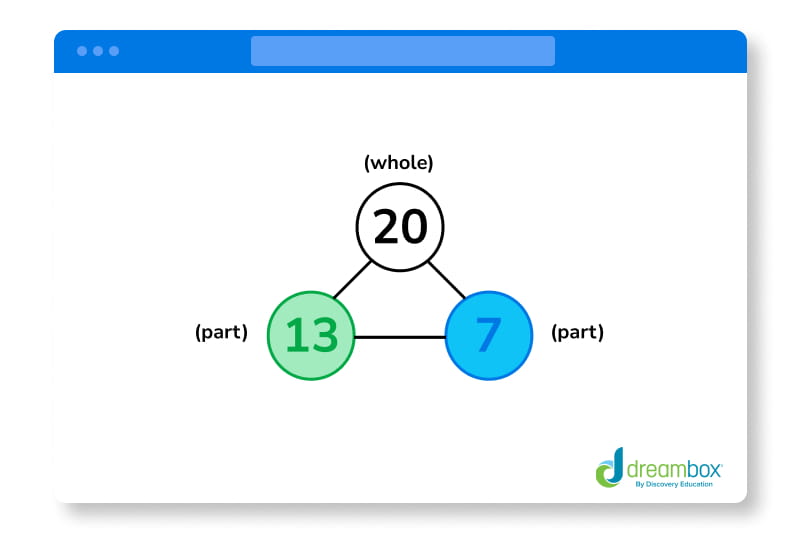
From this number bond, we can create a fact family:
13 + 7 = 20
7 + 13 = 20
20 – 7 = 13
20 – 13 = 7
Some teachers ask their students to memorize fact families, but memorization isn’t the same as understanding.
When teaching, help your students understand the related facts of every number bond. This strengthens their number sense. You can ask students to write out a fact family for every number bond they make. You can also have them create number bonds based on fact families.
If you’re looking for more practice with number bonds, you can find games, informative articles, and classroom activities using online math apps and programs.
Take at home math practice to the next level
Empowering parents and educators to make math practice more impactful. Plus, your kids will love it.