Multiplication Facts
Discover how mastering multiplication facts builds confidence, deepens number sense, and opens the door to more advanced math learning.

Author
Tess Loucka

Published:
December 2025
Key takeaways
- • Multiplication fact fluency allows students to remember facts quickly and easily
- • Strong multiplication skills prepare students to master more advanced concepts
- • Plenty of effective strategies are available to help students learn multiplication facts
Whether you love it, hate it, or fall somewhere in between, understanding multiplication is an essential part of developing as a mathematician. Just like addition and subtraction, multiplication builds the foundation for more advanced math concepts that students learn in later grades. This article focuses on multiplication facts, understanding what they actually mean, when kids are typically ready to start learning them, and why fact fluency matters. We share effective strategies to learn and teach multiplication facts in ways that prepare students to tackle their next math challenges with confidence.
What are multiplication facts?
Multiplication facts are the answers (or products) of multiplying two numbers, usually ranging from 1-10. Students should have a firm grasp of addition and subtraction before starting multiplication, because multiplication builds on that knowledge, allowing students to see patterns, understand how numbers relate, and recognize groups. They’ll need these skills as learning becomes more complex and moves at a quicker pace.
Kids are typically ready to start learning multiplication facts in 3rd grade. At this point, students have usually learned basic addition and subtraction facts and are able to understand terms like ‘2 groups of 5.’ Because multiplication is repeated addition, students initially rely on their addition skills to understand and solve problems. Eventually, they develop fluency.
Multiplication fact fluency is the ability to recall multiplication facts quickly and accurately, without much conscious effort. Students who develop fluency are able to use their long term memory to recall multiplication facts, freeing up their working memory to learn more complex math.
Table of contents
Access more math practice with DreamBox
Turn math into playtime with DreamBox Math
DREAMBOX MATH
Get started for FREE today!

How do you learn multiplication facts?
Achieving fact fluency helps build confidence and prepare students for more advanced math, but how do you get there? Learning multiplication facts requires flexibility and plenty of practice with different approaches until students find what works best for them. That’s why there’s no one size fits all strategy for every learner: some may find rote memorization effective, while others may benefit from a logic based approach, and still others rely on pattern recognition.
Equal Groups, Arrays, and Repeated Addition
Many students begin learning multiplication by exploring equal groups, arrays, and repeated addition.
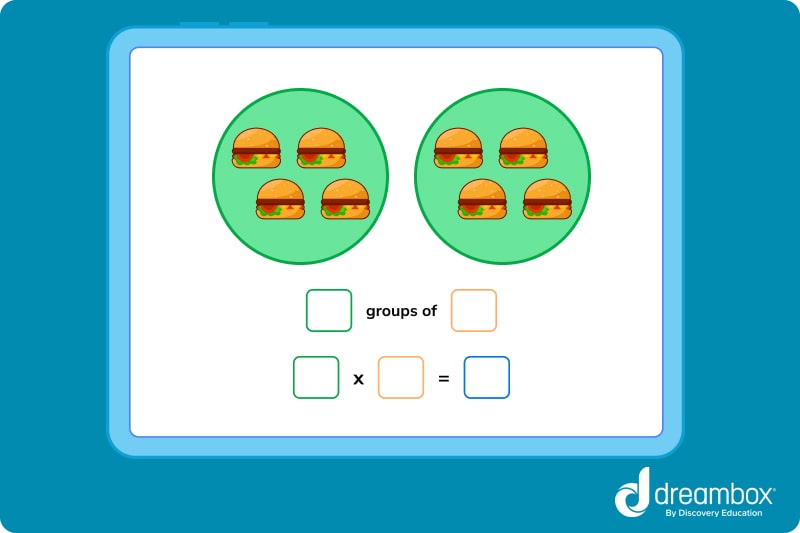
Equal groups show multiplication by displaying a certain number of groups, each with the same number of items. Showing equal groups like the example below is a concrete way for young students to visualize multiplication as repeated addition.
Arrays show multiplication by arranging the items in structured rows and columns, so students can skip count the numbers in each row or column. For example, 2 rows of 3 objects shows 2×3:
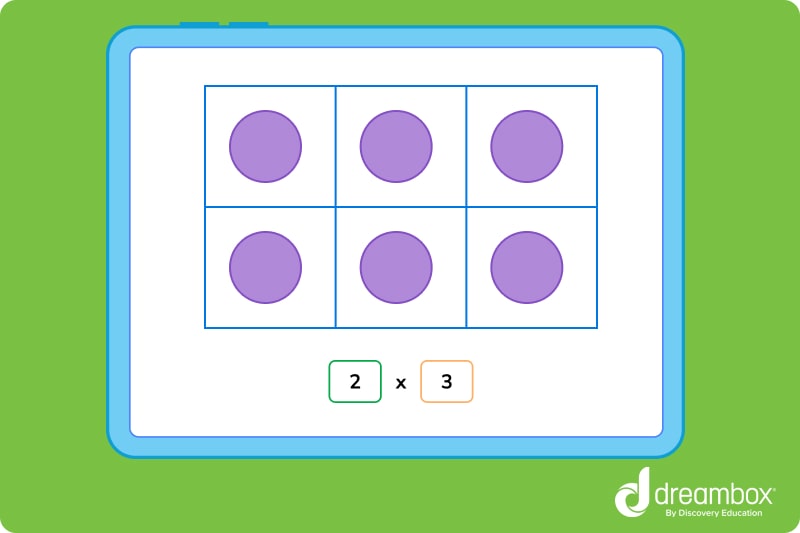
Pictures showing equal groups and arrays are often very helpful at this stage.
Effective Practice Strategies
Gone are the days of rote memorization as the only option for practicing multiplication facts. Today, students can learn many effective strategies in order to master their facts.
Flashcards and Timed Practice
While math education relies less on these traditional methods than in the past, flashcards and timed practice still have a place. Flashcards are a quick way for students to review facts anywhere and repetition has been shown to help move knowledge into long term memory. Reviewing with flashcards also allows students to break down learning into small, manageable chunks. Timed practice requires short bursts of attention that strengthen recall, helping facts become automatic, and gives them a measurable and clear idea of their progress. As a student practices more, their accuracy improves, and they feel more confident and motivated to learn.
Hands-On Practice
If your student enjoys hands-on learning, using visual tools is a great way to learn multiplication facts. Students can use manipulatives (small objects) to create equal groups and arrays. My students loved using M&Ms or these colorful bears. Number line jumps incorporate movement while showing multiplication as repeated addition. A laminated number line and a dry erase marker allows students to visually track equal jumps, noticing patterns and strengthening number sense.
Games and Technology
Card games, dice games, board games, and online games make learning multiplication facts fun and exciting. Research has found that students are more engaged in their learning when they are playing games that contain certain elements, such as teamwork, feedback, and choice. Here are a few of our favorites:
Multiplication Bingo
Multiplication Bingo is played just like the traditional version, only the instructor calls out multiplication problems and the student finds the answers on their game cards. Free and printable cards are available online, and we like this ready-made version–which also includes division–for small groups or a family game night.
This interactive online math program uses animated games and challenges to make learning math fun. Personalized learning plans are tailored to each student’s unique needs, which makes Dreambox perfect for anyone learning multiplication.
Multiplication Yahtzee
This fun twist on the classic dice game is a fun and fast paced way for kids to practice their multiplication facts. Players roll two dice, multiply the numbers together, and find the answer on their score sheet. The first person to find all the answers on their sheet wins! My kids use this template when they’re playing together at home, but you can easily make your own.
No matter what strategies work best for your learner, repeated practice and success builds the confidence they need to master their multiplication facts and be ready for the next challenge.
How Do You Teach Multiplication Facts?
Teachers can support learning multiplication facts in several ways, including by providing concrete examples, choosing effective strategies, providing differentiation and support, and using interactive games to keep things interesting.
When students are first learning multiplication, it’s essential that teachers provide plenty of clear, concrete models that show what multiplication represents, such as counting physical objects in equal groups or using drawings to illustrate repeated addition.
Providing multiple strategies to learn multiplication gives students several tools in their “toolbox” to use when they stumble upon a tricky fact. Here are a few especially effective methods:
- Doubles: 8 x 2 is the same as 8 + 8
- Making 10s: breaking 6 x 7 into (6 x5) + (6 x2)
- Skip Counting: counting by 3s– 3, 6, 9, 12, 15
- Patterns: the product of any number x 5 always ends in a 5 or 0, or when multiplying by 9, the digits of the product always add up to 9, like 9×2=18 or 9×5=45
Visual supports like charts, diagrams, or number lines also give students extra support when learning multiplication.
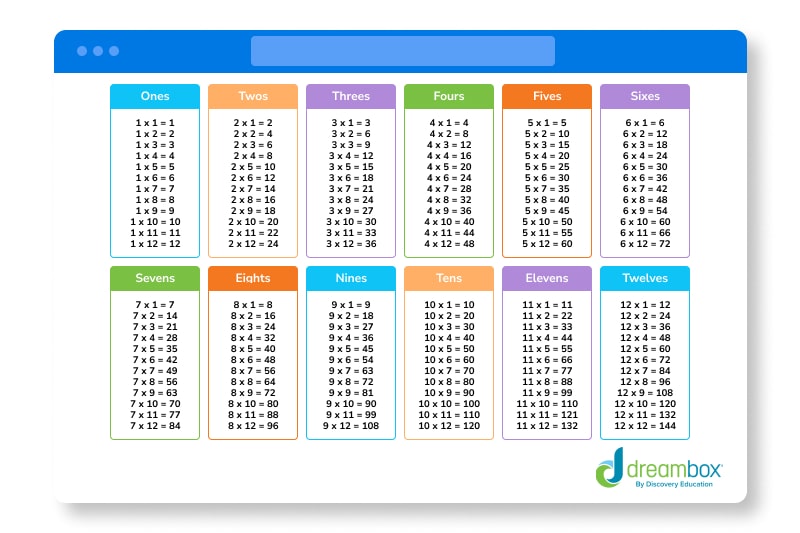
Since every learner is unique, teachers should also use these strategies to provide differentiated support based on their students’ learning needs and ability level. For example, some students may benefit more from hands-on practice, while others thrive on short timed sessions.
Finally, teachers should constantly monitor their students’ progress and give consistent, supportive feedback—to both students and parents—to help their learners build strong multiplication fact fluency. Dreambox Math is a great partner, helping students through interactive lessons, visual models, exciting games, and adaptive practice. Through ongoing assessments, teachers are able to understand exactly what each student needs.
Take at home math practice to the next level
Empowering parents and educators to make math practice more impactful. Plus, your kids will love it.

About the Author
Tess Loucka
Tess Loucka discovered her passion for writing in high school and has not stopped writing since. Combined with her love of numbers, she became a math and English tutor, focusing on middle- and high-school-level topics. Since graduating from Hunter College, her goal has been to use her writing to spread knowledge and the joy of learning to readers of all ages.