5 Fun and Engaging Multiplication Practice Games
What Is a Ten Frame? A Complete Guide to Using Ten Frames in the Math Classroom

Author
Tess Loucka

Published:
August 2026
Key takeaways
- • Ten frames teach number sense, counting, addition and subtraction, and place value.
- • Ten frames are frequently used in kindergarten and 1st grade, but may also be used in 2nd grade.
- • Young students learn best with hands-on ten frame games and activities, like ten frame fill-in-the-blanks and penny math.
What Is a Ten Frame?
A ten frame is a simple tool used to teach young students addition, subtraction, and basic number sense. Helping students visualize amounts is always a challenge, but a ten frame is increasingly becoming educators’ go-to for early math education.
But what is a ten frame? A ten frame is a rectangle split into 10 equal pieces. Students can use them for visualizing numbers, counting, understanding number bonds (what numbers combine to make 10), and addition and subtraction.
How Does a Ten Frame Work?
Whether printed out and passed around to every student or drawn out on the classroom whiteboard, students can use ten frames to visualize counting to ten and basic arithmetic.
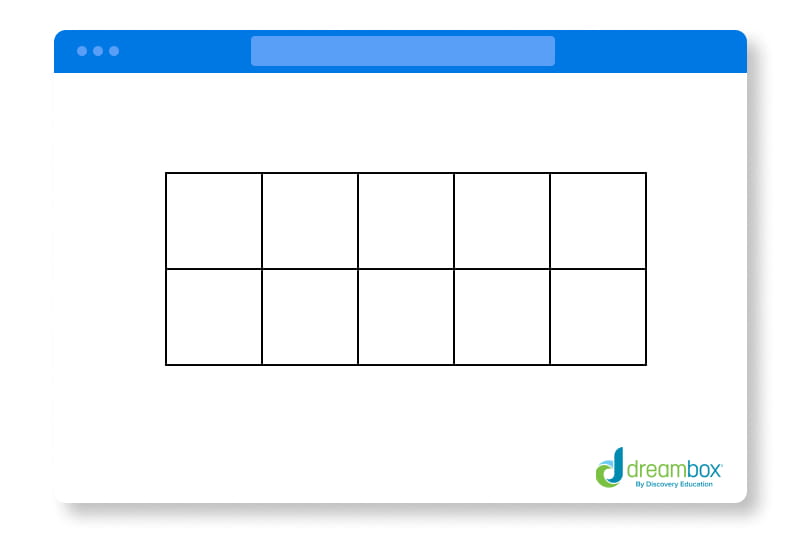
A ten frame is usually paired with counters or placeholders that can be used to mark the individual squares. When learning about number values, a student can use their counters to count to certain numbers within their ten frame.
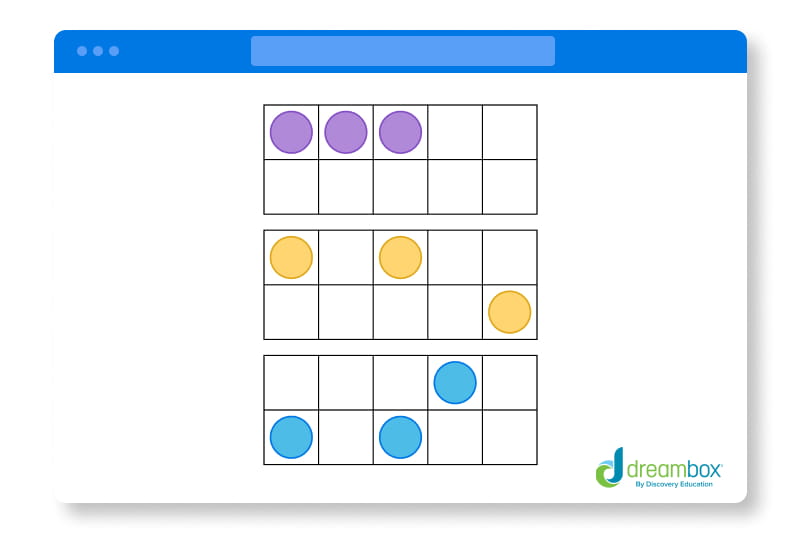
For example, the following three ten frames all represent the number 3 because they each have three spaces filled in.
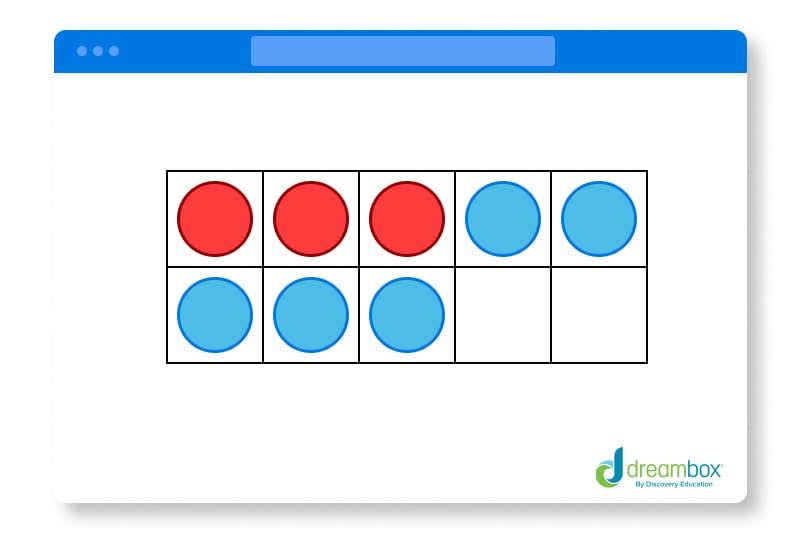
A student can learn how to add by placing counters on their ten frame and counting them. In the following example, a student first placed down 3 red counters, then 5 blue counters. In total, there are 8 counters on the ten frame, meaning 3 + 5 = 8.
Students can similarly learn subtraction, first by placing counters on their ten frame, then removing some and counting the remainder.
Why Are Ten Frames Important in Math?
Ten frames are being used more and more in math classrooms, and it’s not just a fad; ten frames are simple, tangible, and effective tools for young students that put math concepts into perspective.
When students struggle to understand the basic operations up to ten, a ten frame is just the thing to clear up any confusion.
So, how exactly can ten frame math be used in the classroom?
Ten Frames and Number Sense
In early-grade math, developing number sense is key for long-term success. That includes understanding quantities, concepts like “more than” or “less than,” and how basic operations like addition and subtraction work.
Number sense also includes the basic idea that the word “eight” means the same thing as “8” and corresponds to eight separate objects.
You can use ten frames to develop number sense up to 10 and beyond—twenty frames can help teach number sense up to 20 for more advanced students.
Ten Frames and Subitizing
Perceptual subitizing is the ability to see a small collection of objects and immediately know how many objects there are, without counting them.
For instance, we can recognize that someone is holding up four fingers without counting the individual fingers.
Conceptual subitizing involves breaking down larger amounts into smaller, equal parts, without having to think about it.
In other words, most people can see a group of eight objects and immediately understand that the group could be split into two groups of four.
Children develop this skill around the ages of three and four, but can’t master it without practice. That’s where ten frames come in.
A ten frame models numbers and quantities up to 10, based on how many of its squares are filled in. The more students work with ten frames, the more they are seeing visual representations of numbers, thus improving their ten frames subitizing skills.
When Do Students Use Ten Frames in School?
Students mainly use ten frame math in kindergarten and 1st grade. They may be used in 2nd grade, but are less common. As long as students are still in the process of building up their number sense and learning to add and subtract, or simply learning to count to ten, ten frames are a wonderful tool.
Each grade may use ten frames a little differently.
Ten Frames in Kindergarten and 1st Grade
In a kindergarten classroom, the focus is ten frames number sense and teaching students to count to ten.
Ten frames kindergarten students use should help them understand the relationship between digits and real-world values. At this age, they learn that placing counters on their ten frame actually represents numbers, and that all the squares on their ten frame combine to make a total of 10.
Ten frames addition and subtraction is sometimes taught in kindergarten, but this is generally reserved for the 1st grade.
Ten frames 1st grade students use should give them number sense review and help them learn to add and subtract.
Placing counters on a ten frame, counting them, then adding or taking away a few more is a common classroom activity for addition and subtraction. Around this time, students also start to recognize how the number 10 can be broken into smaller, even groups, as well as how number bonds and place value work.
How to Teach with Ten Frames in the Classroom
Young students engage with ten frames best during hands-on lessons. When introducing ten frames, using a whiteboard or projector is fine, but when it comes to real problem solving, it’s best if every student has their own ten frame to work with.
Using Ten Frames for Number Bonds and Place Value
Let’s look at the following ten frames:
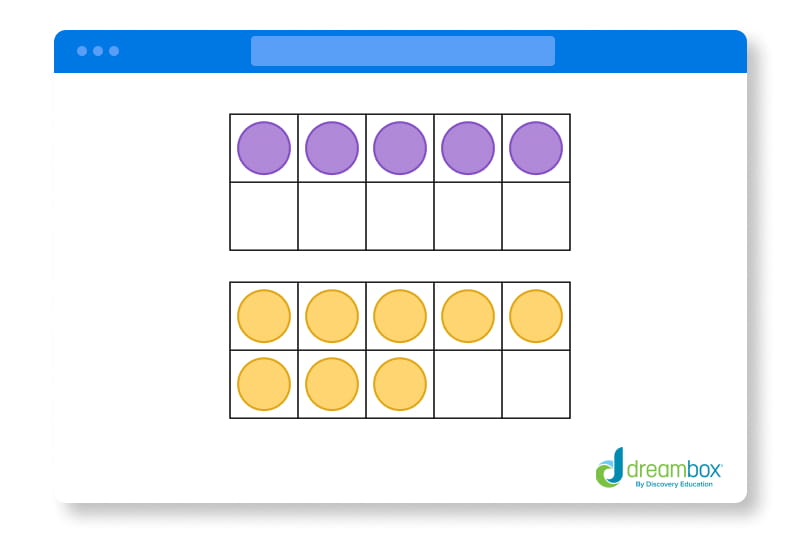
First, students must understand the concept that the combination of the filled-in squares and the empty squares will always equal 10.
So, since the first ten frame has 5 boxes filled in and 5 boxes left empty, the conclusion you want students to draw from this is that 5 and 5 make 10.
In the second ten frame, 8 boxes are filled in and 2 are left empty. Therefore, 8 and 2 make 10. The opposite is also true—2 and 8 make 10.
Every number bond for 10 can be taught using ten frames. After enough repetitions, students should begin to develop their subitizing skills and be able to recognize number bonds without having to count.
Ten frames can also teach students about place value! Completely fill in the first ten frame to make 10, then fill in part of the second one to create a second digit.
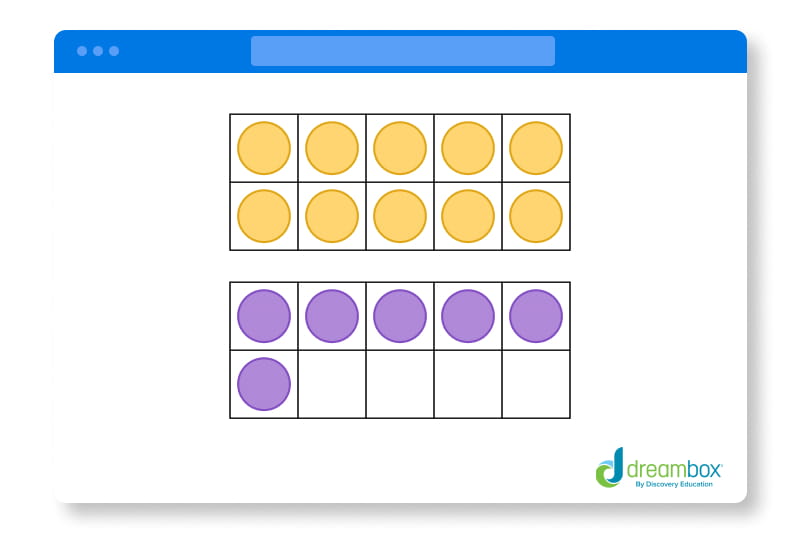
These two ten frames combine to make a double-digit number.
The first ten frame is equivalent to 10, and therefore the digit in the tens place should be 1. The second ten frame has 6 squares filled in, so the ones place should be 6, making 16.
Using Ten Frames for Addition and Subtraction
Learning addition and subtraction with ten frames is all about placing down counters and adding or taking them away.
Take a look at the following ten frames:
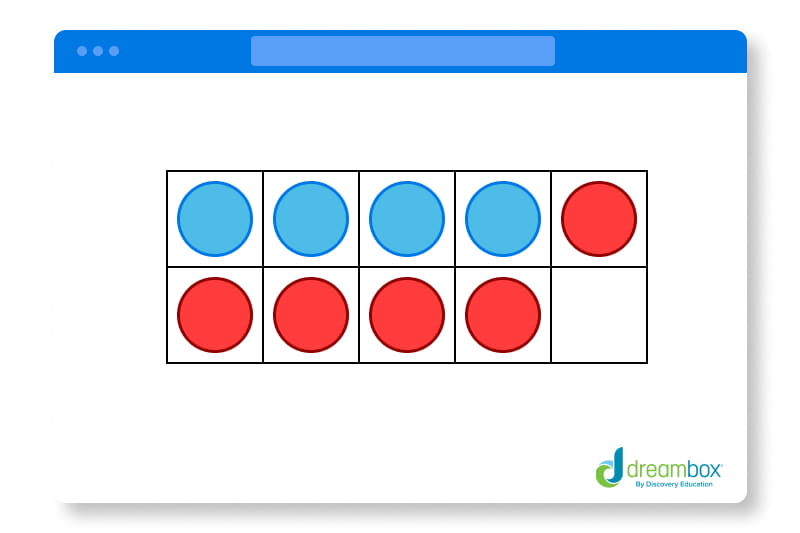
In the first ten frame, there are 4 blue counters and 5 red counters. Ask students how many total counters there are on the ten frame and help them create a simple equation to find the answer. For example, 4 + 5 = 9.
You can use the same ten frame example to create a subtraction problem by using an equation to represent the number of empty squares there are. For instance, 10 – 9 = 1. You could also do 10 – 1 = 9 to determine how many squares are filled in.
Table of contents
Access more math practice with DreamBox
Turn math into playtime with DreamBox Math
DREAMBOX MATH
Get started for FREE today!

Ten Frame Activities and Games for the Classroom
The following ten frame games and activities help students get the most out of their ten frames.
Building Numbers
For this simple activity, the teacher calls out a number, and the student must then place counters on their ten frame to represent it.
Ten Frame Fill-in-the-Blanks
For this activity, all you do is match digits to their corresponding ten frames.
Print out worksheets with multiple ten frames on them that have different amounts of squares filled in, then ask students to write down the corresponding digit, or match the ten frames to a digit “bank.”
You can also draw out a ten frame on a whiteboard and have students call out what digit the ten frame represents.
- Ten Frame Penny Math
This helps students learn about addition and subtraction. First, students take ten pennies (or coins of their choice) and place them in a cup. Next, they shake the cup and pour out the coins. Students can then place the coins on a ten frame in front of them, starting with all the heads-up coins and ending with the tails-up coins.
Finally, students can count how many “heads” and “tails” there are. And, using these numbers, create simple equations using addition and subtraction.
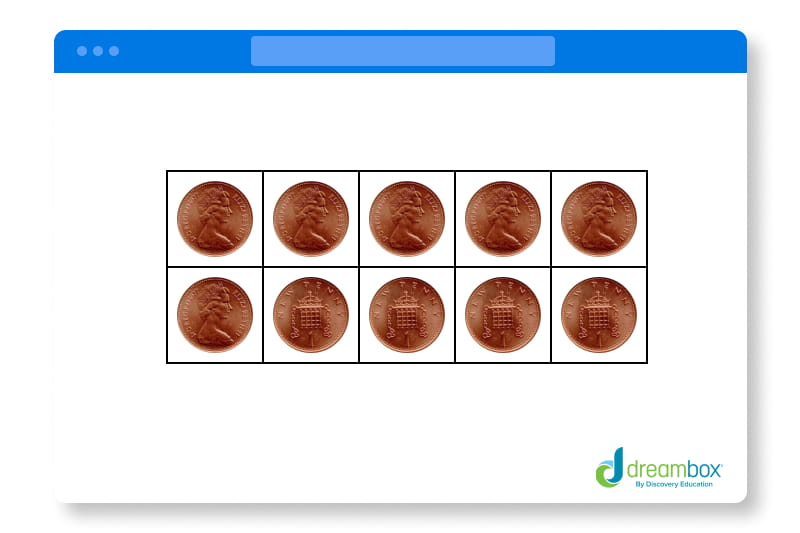
An equation for the ten frame above could be 6 + 4 = 10. Students could also write this equation out as a sentence, saying “Six heads-up pennies plus four tails-up pennies make ten pennies in total.”
Another equation could be 10 – 4 = 6, or “If there are ten pennies and you take away four, there are six remaining pennies.”
How to Make Your Own Ten Frame
To make your own ten frame, simply get a piece of paper, draw a rectangle, and split the rectangle into 10 equal squares.
For most ten frames activities, you’ll be filling in the squares multiple times. So, in addition to the ten frame grid, you’ll also need to gather counters or markers that can be placed down and picked up again and again.
You can purchase small, colorful counters online. But you can also use handmade counters, clay, coins, or small figurines—whatever you have lying around that will grasp your students’ attention.
Still not sure how to incorporate ten frames into your classroom? You can find more information about ten frames and ten frames activities online through math apps and programs.
Take at home math practice to the next level
Empowering parents and educators to make math practice more impactful. Plus, your kids will love it.

About the Author
Tess Loucka
Tess Loucka discovered her passion for writing in high school and has not stopped writing since. Combined with her love of numbers, she became a math and English tutor, focusing on middle- and high-school-level topics. Since graduating from Hunter College, her goal has been to use her writing to spread knowledge and the joy of learning to readers of all ages.