
8th Grade Geometry Guide
Master 8th-grade geometry with this comprehensive guide covering transformations, the Pythagorean Theorem, volume, and triangle proofs, complete with practice questions to sharpen your skills.
Author
Tess Loucka
Published:
February 2026
Key takeaways
- • There are six main concepts students will learn in 8th grade geometry.
- • Students focus on triangles in 8th grade geometry and learn about their properties, classifications, angle measurements, proofs, and more.
- • Students are introduced to geometry proofs in 8th grade.
Geometry is the math that makes up so much of the world around us, from architecture to industry to graphic design. Its whole purpose is to be a tool for understanding how things work. And in 8th grade, students gain a foundation in geometry that can carry them throughout their lives, whatever career path they may head down.
In 8th grade, students work on many interesting geometric concepts, building on what they’ve been introduced to previously, and preparing them for what’s to come in high school.
Let’s go over the six main concepts students will learn in 8th grade. At the end, you can use the five 8th grade geometry practice questions for prep, practice, and review.
Transformations
Transformations in geometry are a type of function that moves figures around the coordinate plane. Transformations are usually classified by whether they change the size of figures (non-rigid) or keep them the same (rigid).
In every transformation, the original position of the figure is defined by its (x, y) coordinates, while its new position is defined by new coordinates, written as (x’, y’) and read as x prime and y prime.
Let’s review the most common geometrical transformations and their properties:
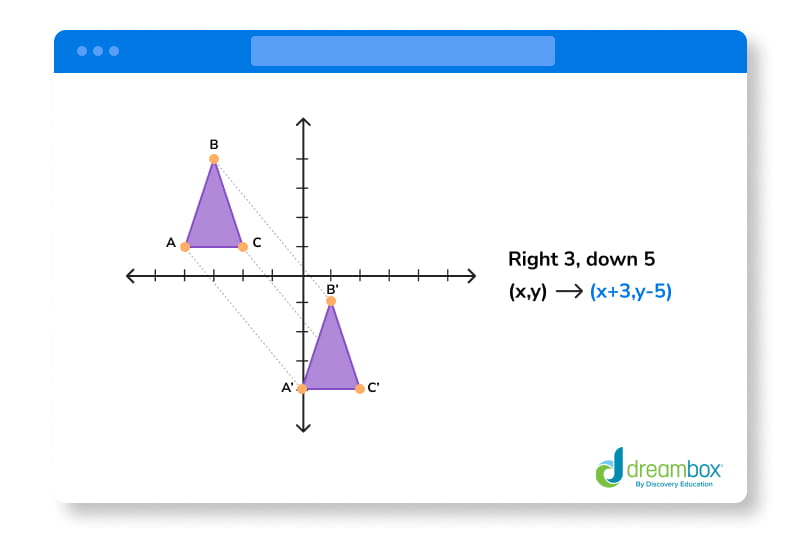
Translation
Translations move figures around the coordinate plane without changing their size or rotation. It simply slides figures from one point to another.
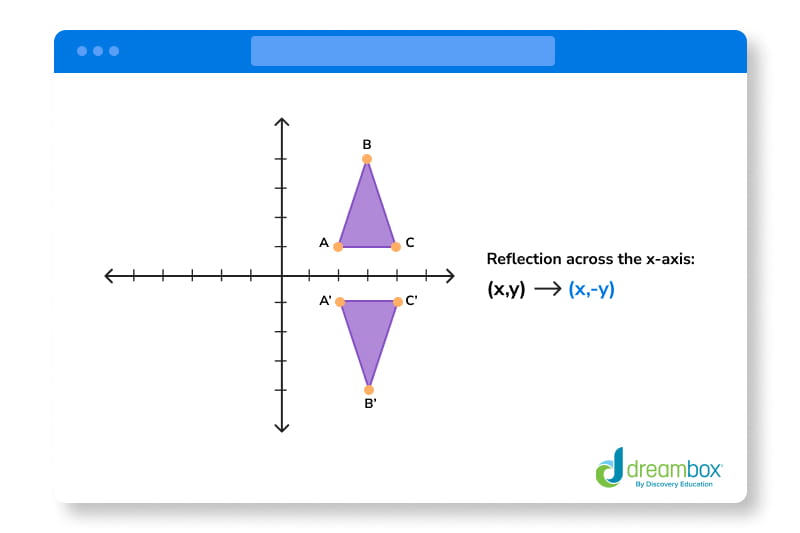
Reflection
Reflection creates a mirror image of a figure by “reflecting” it across a defined line of reflection. This type of transformation does not change the size of a figure but affects its rotation.
The line of reflection used affects how the coordinate points will change:
Reflection across the y-axis: (x, y) → (-x, y)
Reflection across the x-axis: (x, y) → (x, -y)
Reflection across the line x = y: (x, y) → (y, x)
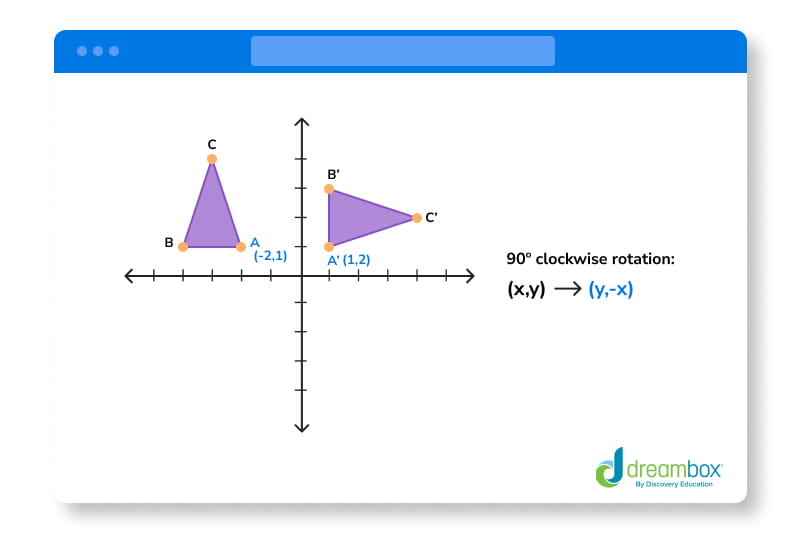
Rotation
Rotation rotates a figure around a specified point. It doesn’t change the figure’s size and shape.
Some rules to remember about rotation:
A 90 degree clockwise rotation: (x, y) → (y, -x)
A 180 degree clockwise rotation: (x, y) → (-x, -y)
A 270 degree clockwise rotation: (x, y) → (-y, x)
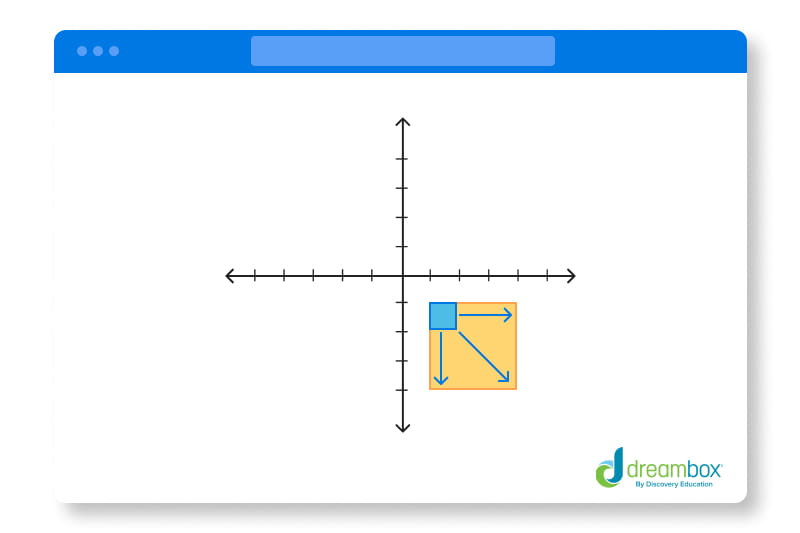
Dilation
Dilation changes the size of a figure and maintains the figure’s shape. Dilation is based on scale factors. Scale factors can be any number, positive or negative.
Table of contents
Practice 8th Grade Math with DreamBox
Pythagorean Theorem
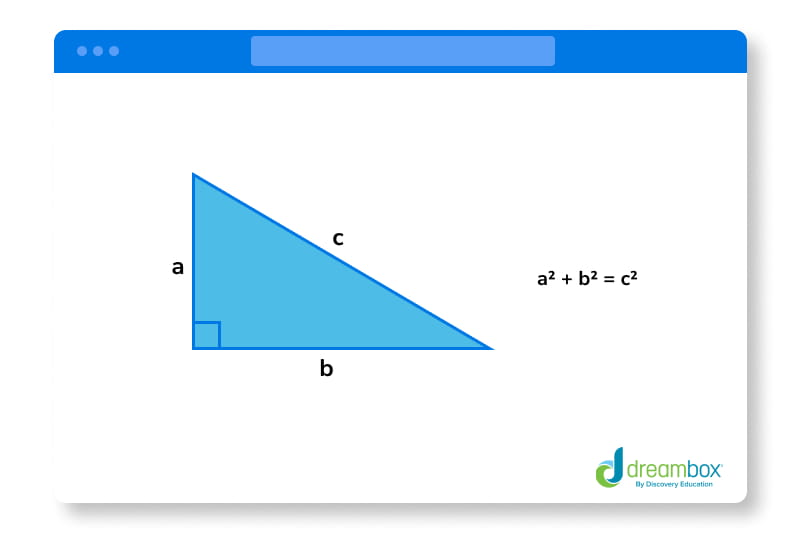
The Pythagorean Theorem says that if you add the squares of the lengths of the legs of a right triangle, it will be equal to the square of the length of the hypotenuse:
a2 + b2 = c2
This theorem can be used to find missing side lengths of right triangles. It’s also useful for determining the distance between two points in space.
Volume
Volume is the measurement of how much space a 3D shape takes up.
In 8th grade geometry, students learn to calculate the volume of spheres, cones, and cylinders. Each volume calculation has its own formula, and it is recommended that students memorize them:
-
The volume of a sphere:
V = 4⁄3πr3, where r = radius -
The volume of a cone:
V = πr2h⁄3, where r = radius and h = height -
The volume of a cylinder:
V = πr2h, where r = radius and h = height
Angles and Lines
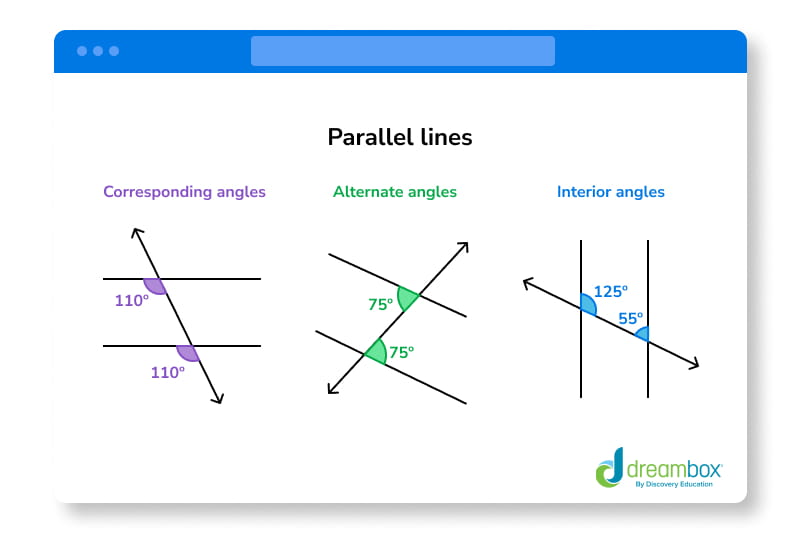
In 8th grade geometry, students learn about the properties of angles, especially those formed by transversals. Transversals are lines that cross through two or more other lines, creating angles at the point of intersection.
The most important angles formed by transversals to remember can be seen in the following diagram:
Corresponding angles have the same measurement.
Alternate angles also have the same measurement.
Interior angles add up to 180 degrees when combined.
Triangles
Triangles get a lot of attention in 8th grade geometry. Students will be introduced to the various triangle properties related to their angles, classifications, measurements, and more.
Students should remember:
The Angle Sum Property – the angles inside every triangle always add up to 180 degrees.
The Exterior Angle Property – the measure of any exterior angle is equal to the sum of the two opposite interior angles.
Side-Angle Relationships – the largest side is opposite the largest angle, and the smallest side is opposite the smallest angle.
Additionally, students should remember how to find the area of a triangle: ½ * base * height.
Geometry Proofs
Proofs are statements or rules that mathematicians use to prove that something is true. As stated above, geometry proofs are a new concept for 8th graders.
In geometry, proofs relate to shapes and are usually used to prove that shapes are congruent (same size and shape) and similar (same shape but different size). They will also be used to compare angles.
To write proofs, students must follow specific formatting guidelines, using statements (observations) and reasons (properties and rules) to prove their point.
Triangles, for instance, have various congruency proofs. These apply to all triangles and can be used to prove or disprove whether two triangles are congruent:
SAS (Side-Angle-Side): If two sides and their included angle are equal, the triangles are congruent.
ASA (Angle-Side-Angle): If two angles and their included side are equal, the triangles are congruent.
AAS (Angle-Angle-Side): If two angles and a non-included side are equal, the triangles are congruent.
SSS (Side-Side-Side): If all three sides are equal in length, the triangles are congruent.
Practice Problems
1. Anthony drives 72 miles north and 20 miles east on Monday. On Tuesday, he drives another 72 miles north and 5 miles east. What is the straight-line distance from where Anthony started to where he ended up?
Answer
He traveled 144 miles north and 25 miles east.
Pythagorean theorem:
a² + b² = c² → 144² + 25² = c²
c = 169 miles.
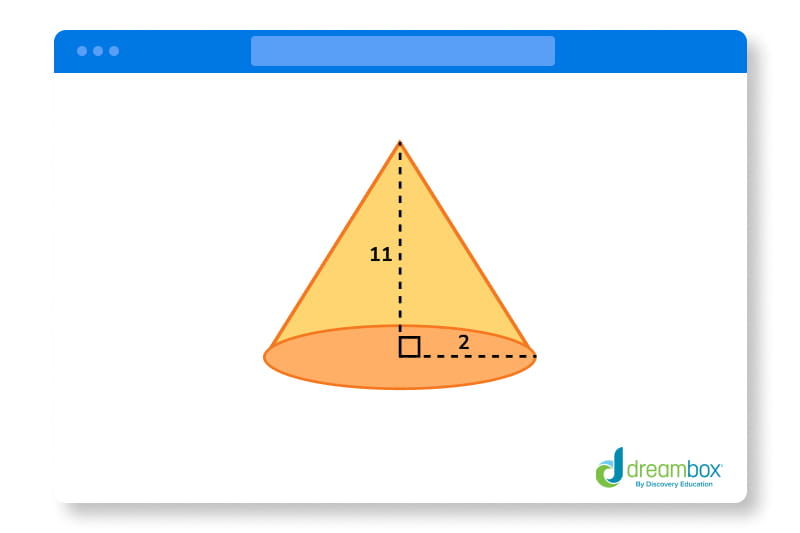
2. What is the volume of the cone?
Answer
Use V = πr²h / 3
V = π(2²)(11)/3
≈ 46.08
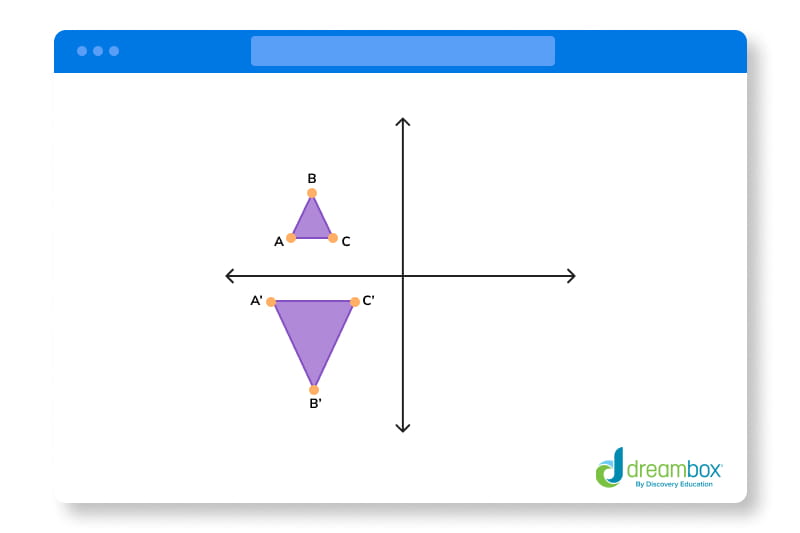
3. What transformation(s) did the triangle below go through?
Answer
The triangle was flipped (reflection).
The new triangle is larger (dilation).
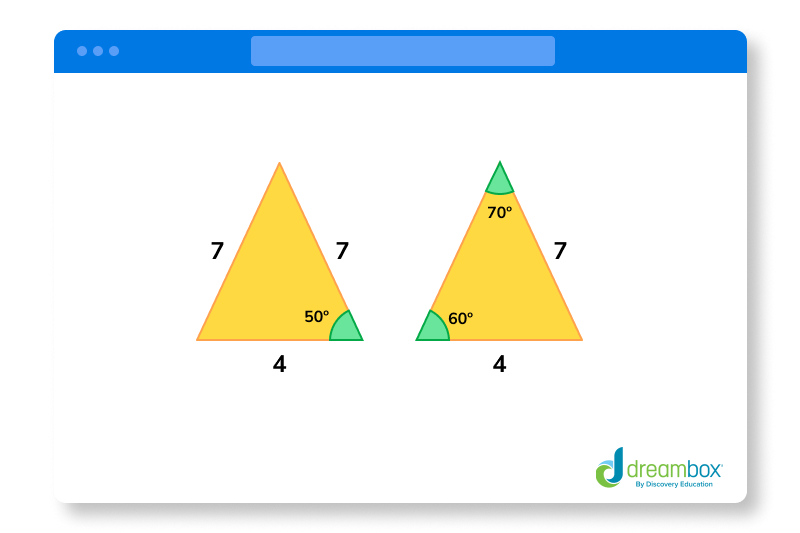
4. Are these two triangles congruent?
Answer
Missing angle = 50°.
Triangles share:
• a 4-unit base
• a 7-unit side
• a 50° included angle
→ SAS → Congruent
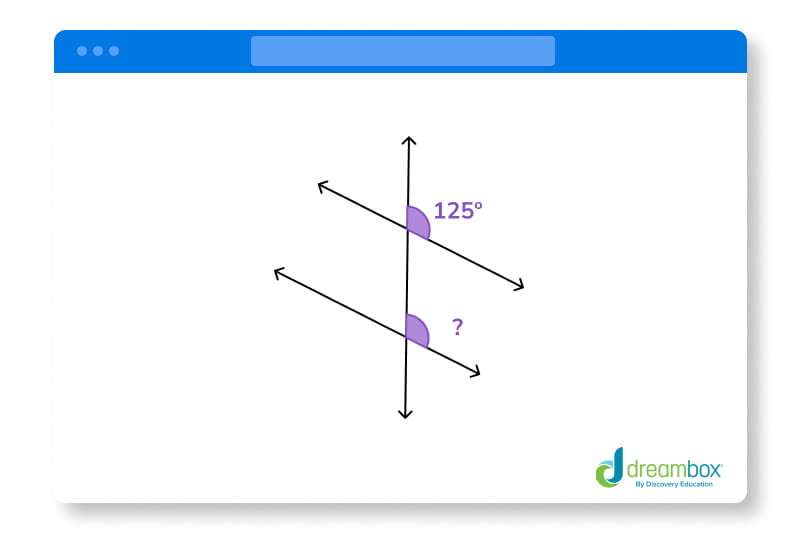
5. Fill in the missing angle measurement:
Answer
They are corresponding angles → equal measures.

For more help with 8th grade geometry, explore math programs, websites, and online courses. Regular review and practice can boost your understanding of any topic, setting you up for success and confidence in class.
Take at home math practice to the next level
Empowering parents and educators to make math practice more impactful. Plus, your kids will love it.
About the Author
Tess Loucka
Tess Loucka discovered her passion for writing in high school and has not stopped writing since. Combined with her love of numbers, she became a math and English tutor, focusing on middle- and high-school-level topics. Since graduating from Hunter College, her goal has been to use her writing to spread knowledge and the joy of learning to readers of all ages.